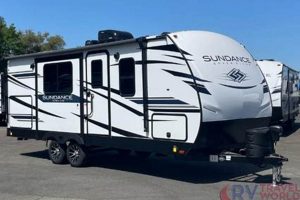
A device facilitating the conversion of direct current (DC) electricity, typically from a battery, into alternating current (AC) electricity, suitable for powering common household appliances. As an example, this allows using a standard AC television or microwave oven in a recreational vehicle where only a DC power source is readily available.
The significance of these devices lies in providing electrical independence when connected to grid power is not possible or practical. This independence enhances the convenience and usability of recreational vehicles. Historically, simpler mobile electrical systems relied solely on DC power, limiting appliance choices. The advent and refinement of power conversion technology has broadened the range of usable devices and improved user experiences.
The subsequent sections will explore selection criteria, installation considerations, operational guidelines, and maintenance practices related to these essential components of modern mobile living.
Travel Trailer Inverter
Proper understanding and application of key principles can significantly enhance the lifespan and performance of a power conversion system in a recreational vehicle. The following tips are designed to promote efficient and safe operation.
Tip 1: Load Calculation is Crucial: Determine the aggregate power consumption of all devices intended for simultaneous operation. This total must remain within the continuous power rating of the device to prevent overload and potential damage. Example: A microwave (1000W) and a coffee maker (800W) require a minimum capacity of 1800W.
Tip 2: Utilize High-Quality Cabling: Employ appropriately sized cables and secure connections for both DC input and AC output. Undersized cabling leads to voltage drop and inefficient power transfer, while loose connections present a fire hazard. Consult amperage charts for appropriate wire gauge based on distance.
Tip 3: Monitor Battery Voltage Consistently: The device relies on a stable DC voltage from the battery bank. Regularly monitor the battery’s state of charge. Deeply discharging batteries will reduce their lifespan. Invest in a battery monitor for accurate readings.
Tip 4: Ensure Adequate Ventilation: These devices generate heat during operation. Proper ventilation is essential to prevent overheating, which can lead to reduced performance or failure. Mount the device in an open area, free from obstructions.
Tip 5: Employ a Dedicated Grounding System: Adhere to all grounding requirements as specified by the manufacturer and relevant electrical codes. Proper grounding minimizes electrical noise and improves safety by providing a path for fault current.
Tip 6: Regular Inspection and Maintenance: Periodically inspect wiring, connections, and ventilation pathways. Clean any accumulated dust or debris. Replace any damaged components promptly.
Tip 7: Consider a Soft-Start Feature: Some appliances, particularly those with motors, draw a significantly higher current during startup. Select a model with a soft-start capability to reduce the strain on the battery bank and the device itself.
Implementing these operational best practices ensures a reliable power supply while extending the service life of the critical component. Attention to these details promotes safety and reduces the risk of unexpected electrical failures.
With these operational considerations addressed, the subsequent section will focus on troubleshooting common issues that may arise during usage.
1. Power Output Capacity

Power output capacity, measured in watts (W) or kilowatts (kW), represents the maximum amount of electrical power a travel trailer inverter can supply to connected devices simultaneously. This specification is a critical factor in determining the suitability of an inverter for a given application. Insufficient capacity leads to overload conditions, potentially damaging the inverter and connected appliances. Conversely, selecting an excessively large inverter results in unnecessary expense and potentially reduced efficiency at lower power demands. For example, a recreational vehicle equipped with a microwave (1200W), a small refrigerator (200W running, 600W startup), and a television (100W) requires a device with a sustained output capacity exceeding the sum of these loads, accounting for startup surges.
The selection of appropriate power output capacity directly impacts the usability and reliability of the travel trailer’s electrical system. Accurately calculating the expected power demand is essential. This involves identifying all appliances intended for simultaneous use and noting their respective power requirements. Moreover, considering the surge current of appliances, particularly those with motors, is critical. Ignoring surge current can result in the inverter tripping its overload protection, interrupting power supply. Many electrical appliances’ power demands exceed their baseline consumption during startup.
In summary, power output capacity constitutes a fundamental performance parameter of a travel trailer inverter. Selecting the appropriate capacity based on a comprehensive assessment of power requirements is paramount to ensuring reliable and safe operation of electrical appliances within the recreational vehicle. Failure to do so can lead to equipment damage, system instability, and compromised usability.
2. Waveform Type (Sine, Modified)

The waveform type produced by a travel trailer inverter significantly influences the performance and compatibility of connected electrical devices. Inverters generate alternating current (AC) electricity from a direct current (DC) source, and the quality of the resulting AC waveform determines its suitability for various applications. Two primary waveform types exist: sine wave and modified sine wave. Sine wave inverters produce a waveform closely resembling that of standard grid power, while modified sine wave inverters generate a stepped approximation of a sine wave.
The choice between sine wave and modified sine wave inverters hinges on the sensitivity of the intended load. Devices containing electronic components, such as computers, televisions, and certain audio equipment, often require a pure sine wave to operate optimally and avoid potential damage. Modified sine wave inverters may introduce noise or distortion into these devices, leading to malfunction or reduced lifespan. Conversely, simpler appliances like incandescent lights or resistive heating elements typically function adequately on a modified sine wave. For example, powering a high-end audio amplifier with a modified sine wave inverter might result in audible hum or distortion, whereas a basic toaster would likely operate without issue. The cause and effect is simple, some devices are very specific in the need of a perfect sine wave.
The selection of an appropriate waveform type is a critical consideration when choosing a travel trailer inverter. While modified sine wave inverters generally offer a lower cost, the potential incompatibility and risk of damage to sensitive electronics often justify the investment in a pure sine wave inverter. Moreover, pure sine wave inverters tend to operate more efficiently and produce less noise, contributing to an improved overall user experience. Therefore, understanding the waveform requirements of intended appliances and devices is essential for ensuring reliable and safe operation of the electrical system.
3. Installation Location

The installation location of a travel trailer inverter is paramount, influencing performance, safety, and longevity. A poorly chosen location can compromise the inverter’s ability to operate efficiently and safely, potentially leading to premature failure or hazardous conditions. Proper consideration of environmental factors, accessibility, and proximity to other system components is essential.
- Ventilation and Temperature Control
Inverters generate heat during operation. Confined spaces with inadequate ventilation lead to elevated operating temperatures, reducing efficiency and lifespan. Locations with free airflow, away from direct sunlight and heat sources, are crucial. The consequences of insufficient ventilation include thermal throttling, reduced power output, and eventual component failure.
- Proximity to Battery Bank
Short, heavy-gauge DC cabling between the battery bank and the inverter minimizes voltage drop and maximizes efficiency. Longer cable runs necessitate thicker, more expensive cabling to mitigate voltage loss. A location adjacent to the battery compartment, within manufacturer-specified distance limits, is generally optimal. This minimizes power loss and ensures the inverter receives adequate voltage.
- Accessibility for Maintenance and Inspection
The inverter requires periodic inspection, cleaning, and potential servicing. A readily accessible location facilitates these tasks. Obstructed or difficult-to-reach installations hinder maintenance efforts and potentially lead to deferred maintenance, compounding minor issues into major problems. Ease of access allows for timely intervention and extends the life of the device.
- Protection from Environmental Elements
Inverters are sensitive to moisture, dust, and physical impact. Installations should shield the device from these hazards. Mounting in a protected compartment, away from direct exposure to the elements, is advisable. Exposure to these elements can lead to corrosion, short circuits, and physical damage, ultimately compromising the functionality of the inverter.
These facets underscore the importance of careful planning when selecting an installation location. A well-chosen location, accounting for ventilation, proximity, accessibility, and environmental protection, maximizes the travel trailer inverters performance, reliability, and service life. Neglecting these considerations can result in compromised functionality and increased maintenance costs.
4. Battery Compatibility

Battery compatibility represents a fundamental aspect of integrating a travel trailer inverter into a recreational vehicle’s electrical system. The inverter’s operational characteristics must align with the battery bank’s specifications to ensure efficient energy conversion and prevent damage to either component. Mismatched voltage levels, battery chemistries, or capacity ratings create operational inefficiencies, reduce the lifespan of the batteries, and potentially compromise the inverter’s functionality. For example, an inverter designed for a 12V system connected to a 24V battery bank will suffer immediate and catastrophic failure, just as a 24v is useless with 12v.
The inverter’s DC input voltage must correspond to the battery bank’s nominal voltage (e.g., 12V, 24V, 48V). Additionally, the battery chemistrysuch as lead-acid (flooded, AGM, GEL), lithium-ion (LiFePO4), or nickel-metal hydride (NiMH)influences the inverter’s charging algorithms and voltage requirements. Using an inverter designed for lead-acid batteries with a lithium-ion battery bank, without proper configuration, can result in overcharging or undercharging, leading to reduced battery life and potential safety hazards. Proper matching can deliver reliable power to the inverter system.
In conclusion, ensuring battery compatibility is paramount to the performance and longevity of both the travel trailer inverter and the battery system. Selecting an inverter that is specifically designed for the intended battery voltage, chemistry, and capacity is essential. Furthermore, adhering to the manufacturer’s guidelines for battery charging and discharging is critical for maintaining system health and preventing premature component failure. Ignoring the requirements of compatibility is a failure of the system as a whole.
5. Protection Features

Protection features are integral to the safe and reliable operation of a travel trailer inverter. These features safeguard the inverter and connected appliances from potential damage arising from electrical anomalies, ensuring continued functionality and preventing hazardous situations. These features are a critical component to overall safety.
- Overload Protection
Overload protection safeguards the inverter against excessive current draw. When the combined power demand of connected appliances exceeds the inverter’s rated capacity, the overload protection mechanism automatically shuts down the inverter, preventing potential damage to its internal components. For instance, if a 2000-watt inverter is subjected to a 2500-watt load, the overload protection will engage, interrupting power output.
- Short-Circuit Protection
Short-circuit protection mitigates the risks associated with unintended electrical connections, such as a direct contact between positive and negative wires. A short circuit results in a rapid surge of current, which can cause severe damage to the inverter and pose a fire hazard. Short-circuit protection detects this abnormal current flow and promptly disconnects the inverter from the power source.
- Over-Temperature Protection
Over-temperature protection prevents damage resulting from excessive heat buildup within the inverter. Inverters generate heat during operation, and inadequate ventilation or prolonged use at high loads can lead to overheating. Over-temperature protection monitors the internal temperature of the inverter and automatically shuts it down if it exceeds a predetermined threshold, preventing component failure.
- Reverse Polarity Protection
Reverse polarity protection safeguards the inverter against damage resulting from incorrect connection of the battery terminals. Connecting the positive terminal of the battery to the negative terminal of the inverter, or vice versa, creates a reverse polarity condition, which can cause irreversible damage to the inverter’s internal circuitry. Reverse polarity protection prevents current flow in the wrong direction, protecting the inverter from this type of fault.
In conclusion, these protection features are essential for ensuring the safe and reliable operation of a travel trailer inverter. They mitigate the risks associated with electrical faults, prevent damage to the inverter and connected appliances, and enhance the overall safety of the recreational vehicle’s electrical system. Neglecting the importance of protection features increases the vulnerability of the entire system.
Frequently Asked Questions
The following addresses common inquiries regarding the application, operation, and maintenance of power conversion systems in recreational vehicles.
Question 1: What is the primary function of a travel trailer inverter?
The primary function is to convert direct current (DC) electricity, typically supplied by a battery bank, into alternating current (AC) electricity, enabling the use of standard household appliances within the recreational vehicle.
Question 2: What factors determine the appropriate size for a travel trailer inverter?
Appropriate size is determined by the aggregate power consumption of all appliances intended for simultaneous operation, including consideration of surge currents for motor-driven devices. Exceeding the inverter’s rated capacity will trigger overload protection or damage the unit.
Question 3: What is the difference between a sine wave and a modified sine wave travel trailer inverter?
A sine wave travel trailer inverter produces an AC waveform closely resembling standard grid power, suitable for sensitive electronics. A modified sine wave inverter generates a stepped approximation of a sine wave, which may cause issues with certain devices.
Question 4: How can battery life be extended when using a travel trailer inverter?
Battery life extension requires monitoring the battery’s state of charge and avoiding deep discharge cycles. Employing high-quality cabling minimizes voltage drop. Turning off the travel trailer inverter when not in use also conserves energy.
Question 5: What safety precautions should be observed when installing a travel trailer inverter?
Safety precautions include selecting an appropriate installation location with adequate ventilation, using appropriately sized and secured cables, ensuring proper grounding, and adhering to all manufacturer’s instructions and relevant electrical codes. Ignoring these precautions can lead to fire and possible death.
Question 6: What are common signs of a failing travel trailer inverter?
Common indicators encompass reduced power output, frequent overload tripping, excessive heat generation, unusual noises, and complete failure to operate. Investigation by a qualified technician is advised when these symptoms manifest.
These responses provide a foundation for understanding the role and proper utilization of these devices within a mobile electrical system.
The subsequent section explores troubleshooting techniques for common problems encountered with travel trailer inverters.
Conclusion
This exposition has illuminated key facets concerning travel trailer inverters, encompassing operational principles, selection criteria, installation considerations, and troubleshooting techniques. Emphasis has been placed on power output capacity, waveform type, battery compatibility, and essential protection mechanisms. A comprehensive understanding of these elements is paramount for ensuring the safe, reliable, and efficient operation of electrical systems within recreational vehicles.
The informed application of the information presented herein will promote the longevity and performance of these critical components. Prudent planning, adherence to established safety protocols, and proactive maintenance practices are crucial for maximizing the benefits derived from a travel trailer inverter while minimizing the risks associated with electrical failures. Prioritizing safety and informed decision-making is of utmost importance.