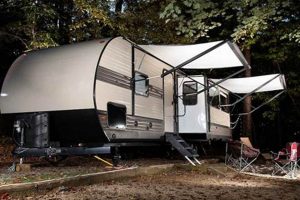
The mechanism responsible for securing the entry point of a recreational vehicle is a critical component. Typically comprised of a handle, deadbolt, and strike plate, it ensures the portal remains closed during travel and provides a level of security against unauthorized entry. Examples range from simple, manually operated devices to more sophisticated electronic systems incorporating keypads and remote controls.
The integrity of this component is paramount for several reasons. Primarily, it prevents the door from swinging open while the vehicle is in motion, averting potential damage to the door itself, the trailer’s exterior, and posing a significant safety hazard to other vehicles. Furthermore, a robust, functioning example offers peace of mind by deterring theft and ensuring the occupants’ privacy and safety within the confined space. Historically, the evolution of these devices has mirrored advancements in recreational vehicle technology, with manufacturers continually seeking improvements in security, ease of use, and durability.
This article will delve into the various types available, common issues encountered, maintenance best practices, and upgrade options that enhance both security and functionality.
Maintenance and Optimization Tips
Ensuring the longevity and reliability of the entry securing mechanism on a recreational vehicle requires adherence to routine inspection and proactive maintenance procedures. The following tips address key areas for optimal performance.
Tip 1: Regular Lubrication: Apply a silicone-based lubricant to all moving parts, including the handle, deadbolt, and latching mechanism. This reduces friction, prevents corrosion, and ensures smooth operation, particularly in harsh weather conditions.
Tip 2: Strike Plate Alignment: Periodically inspect the strike plate on the door frame to ensure proper alignment with the bolt. Misalignment can cause difficulty in closing and securing the door. Adjust or reposition the strike plate as needed.
Tip 3: Handle Tightening: Check the screws securing the handle to the door. Vibration during travel can loosen these screws, leading to instability. Tighten them regularly to maintain a firm grip.
Tip 4: Deadbolt Security: Evaluate the deadbolt’s throw length and ensure it extends sufficiently into the strike plate. A longer throw provides greater resistance against forced entry.
Tip 5: Key Functionality: Test the keys in the lock cylinder periodically. Duplicate keys if originals show signs of wear or damage to ensure continued access.
Tip 6: Weather Stripping Inspection: Examine the weather stripping around the door frame for damage or deterioration. Replacing worn weather stripping prevents water leaks and drafts, which can compromise the mechanism’s integrity.
Tip 7: Address Stiffness Immediately: If the operation of the mechanism becomes stiff or difficult, address the issue promptly. Continued use under these conditions can lead to accelerated wear and potential failure.
Consistent application of these maintenance practices ensures reliable operation and enhances the security of the recreational vehicle.
The subsequent sections will explore upgrade options and troubleshooting common issues.
1. Security Level

The security level directly correlates with the design and construction of the entry securing mechanism on a recreational vehicle. A higher security level necessitates more robust materials, a more complex locking mechanism, and enhanced resistance to forced entry. The primary function is to deter unauthorized access, protecting the occupants and their belongings. For instance, a mechanism employing a double-cylinder deadbolt offers a higher security level compared to a simple spring latch, as it requires a key for operation from both the interior and exterior, complicating potential intrusion.
The materials used significantly impact the security level. A mechanism constructed from hardened steel or reinforced alloys provides greater resistance to drilling, picking, or physical impact than one made from lighter, less durable materials. Furthermore, the precision and complexity of the internal locking components contribute to the overall security. A sophisticated locking mechanism with multiple interlocking pins and anti-pick features inherently provides a higher security level, reducing the risk of lock manipulation. Real-world examples include instances where recreational vehicles equipped with high-security mechanisms successfully deterred attempted break-ins, whereas those with standard mechanisms were more vulnerable.
Ultimately, the security level of the entry securing mechanism is a critical factor in the overall safety and peace of mind for recreational vehicle owners. Selecting a mechanism that aligns with the owner’s security needs and the risk profile of their travel destinations is paramount. While no mechanism is impenetrable, investing in a higher security level significantly reduces the likelihood of unauthorized entry and provides a crucial layer of protection.
2. Material Durability

Material durability constitutes a foundational aspect of the entry point securing mechanism on a recreational vehicle. The inherent qualities of the materials employed directly influence its longevity, resistance to environmental factors, and capacity to withstand potential forced entry attempts. Selecting appropriate materials is, therefore, paramount in ensuring consistent and reliable performance.
- Corrosion Resistance
The susceptibility of component materials to corrosion, particularly in humid or coastal environments, significantly impacts its lifespan. Materials like stainless steel, aluminum alloys with protective coatings, or durable polymers offer enhanced resistance to rust and degradation. For example, mechanisms constructed with zinc-plated steel may exhibit corrosion within a few years of exposure to saltwater, whereas stainless steel alternatives can maintain structural integrity for considerably longer periods. The selection of corrosion-resistant materials directly reduces the need for frequent replacements and ensures the mechanism’s continued functionality in diverse climates.
- Impact Resistance
The capacity to withstand physical impact is crucial for preventing forced entry attempts. Hardened steel, reinforced polymers, and composite materials provide greater impact resistance compared to softer metals or brittle plastics. An instance where a hardened steel deadbolt withstands a forceful impact from a crowbar, while a weaker metal alternative fails, illustrates the importance of material strength. Selecting impact-resistant materials bolsters the security of the recreational vehicle by making it more difficult to breach the entry point.
- UV Resistance
Exposure to ultraviolet radiation from sunlight can degrade certain materials over time, leading to weakening, cracking, and eventual failure. Polymers and plastics used in handles, housings, and other external components should exhibit high UV resistance to prevent premature deterioration. For example, a handle made from UV-resistant polycarbonate will maintain its color and structural integrity for a longer period than one made from standard polypropylene, which may become brittle and discolored after prolonged sun exposure. Utilizing UV-resistant materials ensures the long-term aesthetic appeal and functional reliability of the entire mechanism.
- Wear Resistance
The ability of moving parts to withstand friction and wear is essential for maintaining smooth and consistent operation. Materials with high wear resistance, such as hardened steel alloys and self-lubricating polymers, minimize friction and prevent premature failure of the latching mechanism. For instance, a deadbolt constructed with a wear-resistant coating will maintain its smooth sliding action over years of use, whereas an uncoated metal deadbolt may become difficult to operate due to friction and wear. Selecting wear-resistant materials reduces the likelihood of malfunctions and ensures the longevity of its functionality.
The interplay of these factors highlights the importance of carefully considering material durability when selecting the entry securing mechanism for a recreational vehicle. Prioritizing durable, corrosion-resistant, impact-resistant, UV-resistant, and wear-resistant materials not only enhances security but also ensures the long-term reliability and functionality, providing a worthwhile investment for the recreational vehicle owner.
3. Operational Ease

Operational ease directly influences the user experience and safety associated with a recreational vehicle entry point securing mechanism. A mechanism characterized by smooth, intuitive operation reduces the likelihood of user error, prevents unnecessary strain on components, and facilitates quick egress in emergency situations. The complexity of the design, the ergonomic considerations of the handle and locking mechanism, and the force required for activation all contribute to its operational ease.
The design of the handle itself plays a crucial role. A handle that is easily gripped, even with wet or gloved hands, enables swift and reliable operation. Similarly, a locking mechanism requiring minimal force and a clear, tactile indication of engagement and disengagement minimizes frustration and potential for misoperation. For instance, a mechanism with a stiff, difficult-to-turn deadbolt can cause strain and delay entry or exit, particularly for elderly individuals or those with limited dexterity. In contrast, a properly designed mechanism with a smooth-turning deadbolt and an ergonomically shaped handle significantly enhances the user experience. The practical significance lies in the enhanced security confidence and safety afforded by easy and reliable use, ensuring the securing mechanism functions as intended when most needed. Cases where individuals struggle to open or close a poorly designed recreational vehicle door, particularly during inclement weather or in low-light conditions, highlight the importance of considering operational ease during design and selection.
Ultimately, prioritizing operational ease in the selection and maintenance of a recreational vehicle entry securing mechanism is not merely a matter of convenience, but a crucial aspect of user safety and security. The goal is a system that can be operated swiftly and reliably by all users under diverse conditions.
4. Weather Resistance

Weather resistance is a critical design consideration for the securing mechanism of a recreational vehicle entry point. The operational integrity of this device is directly influenced by its capacity to withstand prolonged exposure to diverse weather conditions. The interplay between environmental factors and the materials and construction of the securing mechanism dictates its long-term reliability and security efficacy. For instance, prolonged exposure to moisture can induce corrosion in metallic components, leading to operational stiffness or complete failure. Similarly, extreme temperature fluctuations can cause expansion and contraction, potentially misaligning the locking mechanism and hindering its ability to properly engage.
The significance of weather resistance is exemplified in situations where recreational vehicles are used in coastal environments or regions with harsh winters. In coastal areas, salt-laden air accelerates corrosion of non-resistant materials, necessitating the use of stainless steel or specialized coatings to maintain functionality. In colder climates, the formation of ice within the mechanism can obstruct movement, requiring de-icing measures or the selection of components that are less susceptible to freezing. The practical application of this understanding involves selecting mechanisms constructed from weather-resistant materials, applying protective coatings, and implementing regular maintenance procedures to mitigate the effects of environmental exposure. This includes lubricating moving parts with weather-resistant lubricants, inspecting seals for damage, and promptly addressing any signs of corrosion.
In summary, weather resistance is not merely an ancillary feature but an essential attribute of a reliable and secure recreational vehicle entry point securing mechanism. The careful selection of materials, coupled with diligent maintenance, ensures continued functionality and provides the occupants with a dependable barrier against the elements and potential security threats. Overlooking the importance of weather resistance can lead to premature failure, compromising both the safety and the security of the recreational vehicle.
5. Installation Integrity

The operational efficacy of a travel trailer door latch is inextricably linked to its installation integrity. Improper installation can negate the benefits of even the highest-quality latch mechanism. Incorrect alignment, loose fasteners, and improperly sized strike plates directly compromise security and functionality. A misaligned strike plate, for example, may prevent the deadbolt from fully engaging, rendering it ineffective against forced entry. Similarly, insufficient screw torque on the latch assembly can cause it to loosen over time due to vibration during travel, increasing the risk of malfunction or complete detachment. The cause-and-effect relationship is clear: compromised installation integrity directly translates to diminished security and operational reliability.
Installation integrity also encompasses the suitability of the latch assembly for the specific door and frame configuration of the travel trailer. Using screws that are too short, for instance, may fail to penetrate the door frame sufficiently to provide adequate holding strength. Similarly, failing to properly seal the latch assembly against the elements can lead to water intrusion and corrosion, further weakening the structure and compromising its functionality. Real-world examples abound of entry securing mechanisms failing prematurely due to improper installation, leading to security breaches and costly repairs. These failures underscore the practical significance of meticulous installation practices and the use of appropriate hardware and sealing materials.
In conclusion, the installation integrity of a travel trailer door latch is not merely a procedural step but a fundamental prerequisite for ensuring its intended performance. Proper alignment, secure fastening, appropriate hardware selection, and effective sealing are all critical components of a robust installation. Neglecting these factors can undermine the entire system, jeopardizing the security and safety of the travel trailer and its occupants. Therefore, prioritizing meticulous installation practices and adhering to manufacturer’s specifications are paramount for realizing the full potential of the door latch mechanism and maintaining the overall integrity of the recreational vehicle.
Frequently Asked Questions
The following section addresses common inquiries regarding the selection, maintenance, and troubleshooting of travel trailer door latches.
Question 1: What constitutes a high-security travel trailer door latch?
A high-security example typically incorporates a deadbolt mechanism, reinforced strike plate, and robust materials such as hardened steel. Features may include pick-resistance and drill-resistance.
Question 2: How frequently should a travel trailer door latch be lubricated?
Lubrication frequency depends on usage and environmental conditions, but a general recommendation is to lubricate all moving parts every three to six months using a silicone-based lubricant.
Question 3: What are the common signs of a failing travel trailer door latch?
Common signs include difficulty locking or unlocking, a loose handle, sticking or binding, and visible corrosion or damage to the components.
Question 4: Can a standard residential door latch be used on a travel trailer?
No. Residential units are not designed to withstand the vibrations and stresses of travel. Travel trailer specific examples are engineered for this purpose.
Question 5: How does weather affect the performance of a travel trailer door latch?
Extreme temperatures, humidity, and salt air can cause corrosion, sticking, and failure. Regular maintenance and the use of weather-resistant materials are crucial.
Question 6: Is it possible to rekey a travel trailer door latch?
Yes, most travel trailer latches can be rekeyed by a qualified locksmith. This is advisable when purchasing a used trailer to ensure security.
Consistent maintenance and informed selection are critical for ensuring reliable entry security.
The next section will explore upgrade options and troubleshooting common issues in greater detail.
Securing Recreational Vehicle Entry Points
The preceding exploration has detailed the critical role of the travel trailer door latch in ensuring the safety and security of recreational vehicles. Its constituent elements, including security level, material durability, operational ease, weather resistance, and installation integrity, are paramount considerations for both manufacturers and owners. The proper selection, maintenance, and installation of this component directly impact the protection of occupants and their belongings.
Given the inherent vulnerabilities associated with mobile living, a proactive approach to securing recreational vehicle entry points is essential. Continued diligence in evaluating existing mechanisms, coupled with informed decisions regarding upgrades and preventative maintenance, will contribute to enhanced security and peace of mind. Further research and development in latch technology will likely yield even more robust and user-friendly solutions in the future.