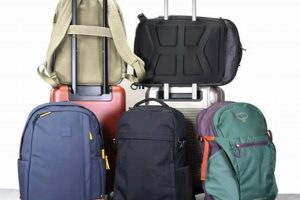
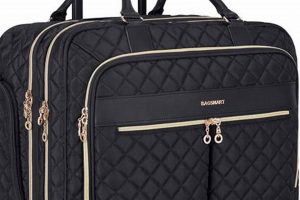
A wheeled suitcase, frequently referred to as luggage with wheels, is a type of bag equipped with wheels and a telescoping handle to facilitate transportation. These bags are designed to reduce the physical strain associated with carrying heavy loads, particularly during travel. An example includes a standard suitcase featuring two or four wheels and a retractable handle for pulling or pushing.
The development of mobile luggage has significantly improved the travel experience. Its utility extends to individuals of all ages and physical abilities, mitigating potential back strain and promoting ease of movement through airports, train stations, and other transit hubs. From a historical perspective, the introduction of wheeled luggage marked a shift towards prioritizing convenience and practicality in travel accessories, impacting the design and functionality of modern luggage.
This article will delve into the various aspects of mobile luggage, exploring its different types, materials, construction, and key features to consider when selecting the optimal bag for specific travel needs. Furthermore, maintenance tips and security considerations will be discussed to ensure the longevity and protection of belongings during transit.
Tips for Optimal Use of Wheeled Luggage
This section provides guidelines for maximizing the utility and lifespan of wheeled luggage, ensuring a seamless and efficient travel experience.
Tip 1: Select the Appropriate Size. Assess the duration of the trip and the volume of items to be transported before choosing a size. Overpacking can strain the wheels and handle, while underpacking may lead to shifting contents.
Tip 2: Distribute Weight Evenly. Arrange contents within the bag to ensure balanced weight distribution. This minimizes stress on the wheels and prevents tipping during transit. Place heavier items near the wheel base.
Tip 3: Utilize Packing Accessories. Employ packing cubes or compression bags to organize belongings and minimize wasted space. This also aids in preventing shifting during transport, protecting fragile items.
Tip 4: Inspect Wheels Regularly. Examine the wheels for damage or debris prior to each journey. Clean wheels with a damp cloth to remove dirt and grime, ensuring smooth rolling performance.
Tip 5: Extend and Retract Handle with Caution. When extending or retracting the telescoping handle, ensure it is fully locked in place. Avoid forcing the handle, as this can damage the locking mechanism.
Tip 6: Secure Contents Properly. Utilize internal straps or dividers to secure belongings within the luggage. This minimizes movement and prevents damage to fragile items during transit.
Tip 7: Adhere to Airline Restrictions. Familiarize yourself with airline size and weight restrictions for carry-on and checked baggage. Overweight or oversized items may incur additional fees or be prohibited.
By adhering to these guidelines, users can optimize the functionality and longevity of their wheeled luggage, ensuring a more comfortable and efficient travel experience.
The subsequent section will address security measures for protecting belongings while utilizing wheeled luggage during travel.
1. Maneuverability

Maneuverability is a critical performance attribute of rolling travel bags, directly influencing the ease with which a traveler can navigate diverse environments. The connection between the two is causal: superior maneuverability reduces physical strain and increases travel efficiency. A bag’s maneuverability is fundamentally determined by the quality, configuration, and number of its wheels, as well as the design of its telescoping handle. Poor maneuverability, conversely, can lead to frustration and delays, especially in congested areas like airports and train stations.
Real-world examples illustrate the practical significance of this connection. A rolling travel bag with multi-directional spinner wheels allows for seamless 360-degree rotation, facilitating effortless movement through tight spaces. In contrast, a bag with fixed, in-line skate wheels requires more effort to turn and is less suited for navigating crowded terminals. Handle design also plays a crucial role; an ergonomically designed handle with adjustable height settings provides a comfortable grip and enhances control over the bag’s movement. Bags with inflexible handles, or those that are too short for the user, impede maneuverability and can cause discomfort.
In conclusion, maneuverability is an indispensable component of rolling travel bag functionality. The design and construction of wheels and handles are key determinants of how effectively a bag can be maneuvered. Prioritizing maneuverability during the selection process is essential for ensuring a smoother, more efficient, and less physically demanding travel experience. Challenges remain in developing bags that maintain robust maneuverability while adhering to size and weight restrictions imposed by airlines, requiring ongoing innovation in materials and design.
2. Durability

Durability is a paramount attribute of rolling travel bags, directly influencing their longevity and ability to withstand the rigors of travel. A robust design and construction translate to an extended lifespan and reduced risk of damage to contents. The connection between durability and a rolling travel bag’s usefulness is causal: increased durability protects belongings and mitigates the need for frequent replacements. Durability is dependent on material quality, construction techniques, and reinforcement of stress points such as wheels, handles, and zippers. A lack of durability can lead to premature wear, breakage, and compromised security, resulting in inconvenience and potential financial loss for the traveler.
Real-world examples demonstrate the practical significance of durability. A bag constructed from ballistic nylon or reinforced polycarbonate can withstand rough handling during airport baggage processing, protecting fragile items within. Conversely, a bag made from flimsy material is susceptible to tears and punctures, exposing contents to damage. Heavy-duty zippers and reinforced seams prevent separation under stress, while sturdy wheels ensure smooth rolling over varied surfaces. The selection of durable components and rigorous quality control measures during manufacturing directly impact the bag’s ability to endure frequent travel.
In summary, the durability of a rolling travel bag is a key determinant of its overall value and suitability for travel. Material selection, construction methods, and reinforcement of vulnerable areas are crucial factors contributing to durability. While cost may be a consideration, investing in a durable bag typically provides a better return on investment over time by minimizing the need for replacements and safeguarding belongings. Ongoing challenges involve balancing durability with weight and cost considerations, prompting innovation in lightweight yet robust materials and manufacturing processes.
3. Capacity
Capacity, in the context of rolling travel bags, refers to the internal volume available for storing belongings. It is a critical factor in determining the suitability of a bag for a given trip, influencing packing efficiency and overall travel convenience. A bag’s capacity directly impacts the amount of clothing, accessories, and other essential items a traveler can transport, thereby affecting the length and type of trips for which it is appropriate.
- Internal Dimensions and Volume
Internal dimensions, typically measured in inches or centimeters, dictate the physical space available within the bag. Volume, expressed in liters or cubic inches, provides a standardized metric for comparing the storage capacity of different bags. For example, a carry-on sized rolling bag may have a volume of 40-50 liters, while a larger checked bag can exceed 100 liters. Variations in internal dimensions and volume directly affect the quantity and size of items that can be packed.
- Expandable Features
Certain rolling travel bags incorporate expandable features, such as zippered compartments that can be unzipped to increase the bag’s overall capacity. These features provide flexibility for travelers who anticipate acquiring additional items during their trip. However, expanded bags may exceed airline size restrictions, necessitating caution when utilizing this functionality. Real-world examples include souvenirs and duty-free purchases that might require extra space on the return journey.
- Compartmentalization and Organization
The internal layout of a rolling travel bag, including the presence of dividers, pockets, and straps, significantly impacts its usable capacity. Well-designed compartments facilitate organized packing, preventing items from shifting during transit and optimizing space utilization. For example, separate compartments for shoes and toiletries can prevent contamination of clothing items, while compression straps can minimize the overall volume of packed garments.
- Weight Considerations
While capacity refers to volume, it is intrinsically linked to weight. Overfilling a rolling travel bag, even if the items physically fit, can exceed airline weight restrictions, resulting in additional fees or the need to remove items. Furthermore, excessive weight can strain the bag’s wheels and handle, potentially compromising its durability. Travelers must balance their packing needs with weight limitations to ensure a smooth and cost-effective travel experience.
In conclusion, capacity represents a fundamental aspect of rolling travel bag selection, with internal dimensions, expandable features, compartmentalization, and weight considerations all influencing the practicality and efficiency of packing. Choosing a bag with appropriate capacity, while adhering to weight restrictions and optimizing internal organization, is essential for a successful travel experience.
4. Security
Security, in the context of rolling travel bags, represents the measures implemented to protect the bag’s contents from theft, damage, and unauthorized access. It is a critical consideration for travelers, influencing peace of mind and safeguarding valuable possessions. Effective security features minimize the risk of loss and ensure the integrity of belongings throughout the journey.
- Locking Mechanisms
Locking mechanisms, such as TSA-approved combination locks or keyed locks, deter opportunistic theft by securing the bag’s main compartment. TSA-approved locks allow security personnel to inspect the contents without damaging the lock. Examples include integrated locking systems on the bag itself or external padlocks. Ineffective locks can be easily bypassed, compromising the bag’s security.
- Material Construction
The material used in the construction of the rolling travel bag contributes significantly to its security. Slash-resistant materials, such as reinforced nylon or interwoven metal mesh, prevent thieves from cutting into the bag and accessing its contents. Weak or easily cut materials provide minimal protection against theft. Real-world scenarios highlight the importance of robust material construction in deterring tampering.
- Zipper Design and Security
Zipper design plays a critical role in the overall security of the bag. Interlocking zippers, tamper-evident zippers, or zippers with hidden or reinforced closures make it more difficult for unauthorized individuals to open the bag discreetly. Standard zippers can be easily forced open or manipulated. Secure zipper designs act as a visual deterrent and physical barrier against theft.
- Tracking and Recovery Systems
Modern rolling travel bags may incorporate tracking and recovery systems, such as GPS trackers or RFID tags, which aid in locating lost or stolen luggage. These systems provide an added layer of security by increasing the chances of recovering the bag in the event of loss or theft. While not a primary security feature, tracking systems offer valuable peace of mind and potential for recovery.
In conclusion, security is a multifaceted aspect of rolling travel bag design, encompassing locking mechanisms, material construction, zipper security, and tracking systems. Implementing effective security measures is essential for protecting belongings during travel and minimizing the risk of theft or loss. Travelers should carefully evaluate the security features of a rolling travel bag to ensure it meets their specific needs and risk tolerance.
5. Dimensions
Dimensions, in relation to rolling travel bags, denote the external measurements of the bag, typically expressed as length, width, and height. This aspect is critical as it directly influences compliance with airline regulations, storage capacity, and ease of handling. Selecting a bag with appropriate dimensions ensures a seamless travel experience, avoiding potential issues at check-in and during transit.
- Carry-On Compliance
A primary consideration regarding dimensions is adherence to carry-on size restrictions imposed by airlines. These restrictions vary slightly between carriers but generally fall within a specified range. Non-compliance can result in the bag being relegated to checked baggage, incurring additional fees and increasing the risk of loss or damage. Real-world examples include bags exceeding the maximum allowable dimensions for overhead compartments, leading to mandatory gate checking.
- Checked Baggage Limits
For larger rolling travel bags intended as checked baggage, dimensions are also relevant. Airlines often impose maximum size limits for checked bags, and exceeding these limits can result in excess baggage charges. Furthermore, oversized bags may be more susceptible to damage during handling due to their increased surface area and potential for entanglement with conveyor systems. The overall dimensions of the bag, therefore, must be considered in relation to airline policies.
- Internal Volume and Usability
While external dimensions are important for compliance, internal dimensions directly correlate with the usable volume of the bag. Bags with similar external dimensions may have varying internal volumes due to differences in construction and design. Maximizing internal volume within allowable external dimensions is a key factor in optimizing packing efficiency. Features such as recessed handles and optimized internal compartments contribute to increased usability within a given dimensional envelope.
- Maneuverability and Storage
The overall dimensions of a rolling travel bag also affect its maneuverability and storage. Overly large bags can be difficult to maneuver through crowded airports and train stations, while excessively wide bags may not fit comfortably through narrow aisles. Furthermore, storage considerations at home or in hotel rooms necessitate careful consideration of the bag’s dimensions. A balance between capacity and manageability is essential for a positive travel experience.
In summary, dimensions are a fundamental aspect of rolling travel bag selection, influencing airline compliance, internal volume, maneuverability, and storage considerations. Choosing a bag with appropriate dimensions ensures a hassle-free travel experience and optimizes packing efficiency while adhering to airline regulations and personal storage constraints.
Frequently Asked Questions
This section addresses common inquiries regarding wheeled luggage, providing informative answers to aid in selecting and utilizing these travel accessories effectively.
Question 1: What constitutes the ideal size for a carry-on rolling travel bag?
The ideal size for a carry-on wheeled bag is determined by airline restrictions, typically falling within a range of 22 x 14 x 9 inches (56 x 36 x 23 cm). However, it is imperative to verify specific carrier regulations prior to travel, as variations may exist.
Question 2: What materials are considered most durable for rolling travel bags?
Ballistic nylon and polycarbonate are widely regarded as durable materials for wheeled bags. Ballistic nylon offers excellent abrasion resistance, while polycarbonate provides impact resistance and protection against crushing forces.
Question 3: How should weight be distributed within a rolling travel bag to prevent damage?
Weight distribution should prioritize placing heavier items near the wheel base to maintain stability and minimize strain on the handle and wheels. Even distribution across the bag’s width and length further enhances stability.
Question 4: What type of locking mechanism is recommended for securing a rolling travel bag?
A TSA-approved combination lock is generally recommended. These locks allow security personnel to inspect the contents without damaging the lock while providing a deterrent against opportunistic theft.
Question 5: How can the lifespan of a rolling travel bag’s wheels be extended?
Regular cleaning to remove dirt and debris, periodic lubrication with appropriate lubricants, and avoiding overloading the bag can extend the lifespan of the wheels. Additionally, traversing rough surfaces cautiously minimizes wear and tear.
Question 6: What are the key considerations when selecting a rolling travel bag for international travel?
Key considerations include adherence to international airline carry-on and checked baggage size and weight restrictions, durable construction to withstand rough handling, and appropriate security features to protect belongings in unfamiliar environments.
In summary, proper selection and utilization of rolling travel bags involve careful consideration of size, material, weight distribution, security features, and maintenance practices.
The following section will explore advanced features and emerging trends in rolling travel bag technology.
Conclusion
This article has comprehensively explored the “rolling travel bag,” examining its core components, optimal usage guidelines, and critical selection criteria. Key aspects such as maneuverability, durability, capacity, security, and dimensions have been dissected, providing a detailed understanding of the factors influencing the functionality and suitability of these bags for diverse travel needs. The analysis underscored the importance of considering individual travel requirements when choosing a “rolling travel bag,” balancing factors like airline compliance, storage capacity, and security measures.
The efficacy of a “rolling travel bag” is contingent upon thoughtful selection and responsible use. Understanding the nuances of construction, security, and dimensional constraints empowers travelers to make informed decisions that enhance their travel experience and safeguard their belongings. The continued evolution of materials and designs promises further advancements in wheeled luggage, demanding ongoing awareness of emerging trends to optimize travel efficiency and security.