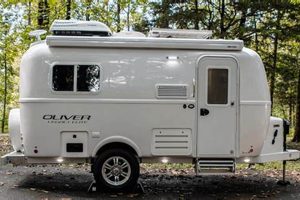
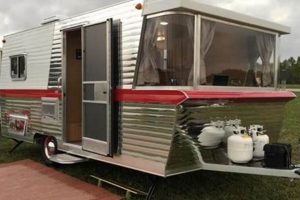
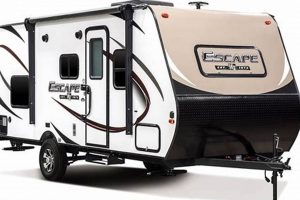
A cooling system designed specifically for recreational vehicles intended for leisure travel and temporary residence constitutes a critical component of mobile comfort. This climate control appliance provides temperature regulation within the confined living space of a towable camper, often operating via electrical power derived from either a generator, shore power connection, or battery bank.
Effective temperature management within a recreational vehicle enhances user experience significantly, contributing to improved sleep quality, reduced heat stress, and preservation of sensitive equipment. Historically, these units have evolved from simple evaporative coolers to sophisticated, multi-functional systems incorporating features such as dehumidification and multi-speed fan control, reflecting advances in refrigeration technology and power management.
The subsequent sections will detail the various types of cooling apparatuses available, factors influencing selection, installation considerations, maintenance protocols, and operational best practices for optimal performance and longevity. Attention will also be directed towards troubleshooting common issues and understanding energy efficiency ratings.
Operational and Maintenance Recommendations
Optimizing the performance and lifespan of recreational vehicle cooling systems requires adherence to established operational and maintenance procedures. These recommendations are intended to provide guidance for achieving efficient and reliable climate control.
Tip 1: Pre-Departure Inspection: Prior to commencing travel, inspect the unit for physical damage, debris accumulation, and secure mounting. Ensure all vents are unobstructed and the unit is level for optimal drainage.
Tip 2: Regular Filter Maintenance: Air filters should be inspected and cleaned or replaced regularly, typically every 30-90 days depending on usage and environmental conditions. Clogged filters reduce airflow and decrease cooling efficiency.
Tip 3: Condenser Coil Cleaning: Periodically clean the condenser coils located on the exterior of the unit. Use a soft brush or fin comb to remove dirt and debris. Avoid using high-pressure water, which can damage the fins.
Tip 4: Seal Inspection: Inspect the seals around the units mounting flange on the roof for cracks or deterioration. Replace damaged seals to prevent water leaks into the recreational vehicle.
Tip 5: Proper Voltage Management: Ensure the unit receives the correct voltage as specified by the manufacturer. Voltage fluctuations can damage the compressor and other electrical components. Utilize a surge protector when connecting to shore power.
Tip 6: Shade Optimization: Park the recreational vehicle in shaded areas whenever possible to reduce solar heat gain, thereby lessening the workload on the cooling system and conserving energy.
Tip 7: Periodic Professional Servicing: Schedule a professional inspection and servicing of the unit at least once every two years. A qualified technician can identify and address potential issues before they escalate into costly repairs.
Adherence to these maintenance protocols will contribute to the prolonged operational efficiency, overall reliability, and longevity of the recreational vehicle’s cooling system.
The following section will address common troubleshooting scenarios and provide guidance on resolving minor issues without requiring professional assistance.
1. Cooling Capacity (BTUs)

Cooling capacity, measured in British Thermal Units (BTUs), is a crucial specification for any climate control unit intended for recreational vehicles. BTU rating defines the system’s capacity to remove heat from a defined space within a given timeframe. In the context of a recreational vehicle, BTU requirements are intrinsically linked to the volume of the interior space, insulation effectiveness, window area, and external environmental factors like ambient temperature and direct sunlight exposure. Insufficient cooling capacity will result in inadequate temperature reduction, causing discomfort and potentially damaging sensitive electronics due to overheating. Conversely, excessive cooling capacity leads to inefficient operation, increased energy consumption, and potentially rapid cycling of the compressor, shortening the appliance’s lifespan.
The selection of an appropriate BTU rating for a recreational vehicle mandates a precise assessment of the aforementioned variables. For instance, a smaller recreational vehicle, such as a pop-up camper, may only require a 5,000 to 8,000 BTU unit. Larger travel trailers, particularly those with multiple slide-outs and expansive window areas, could necessitate a 13,500 to 15,000 BTU unit, or even multiple units, to maintain a comfortable internal climate. Furthermore, regional climate variations significantly influence BTU requirements; recreational vehicles frequently used in hot and humid environments will demand higher BTU ratings compared to those primarily used in temperate climates. Proper sizing also ensures the unit operates efficiently, preventing excessive energy consumption and minimizing strain on the recreational vehicle’s electrical system.
Accurate determination of BTU requirements is thus fundamental to ensure both user comfort and operational efficiency within recreational vehicles. Employing a BTU calculator that considers factors such as square footage, insulation levels, window area, and climate is highly recommended. Overlooking this crucial step can lead to discomfort, increased energy costs, and premature failure of the climate control equipment. Selecting a properly sized system is therefore not merely a matter of convenience, but an economic and practical necessity.
2. Power Consumption (Amps)

The amperage draw of a recreational vehicles cooling system is a critical parameter directly influencing the operational feasibility and energy management strategies within the mobile environment. Amperage, measured in amps, quantifies the electrical current required by the unit to operate, significantly affecting generator sizing, battery bank capacity, and shore power compatibility. Underestimating the amperage requirement can result in tripped circuit breakers, generator overload, and the inability to simultaneously operate other essential appliances. Conversely, selecting a unit with unnecessarily high amperage requirements leads to inefficient energy utilization and increased operational costs. A cooling system with a high amperage draw places a significant burden on the electrical infrastructure of the recreational vehicle.
Consider a recreational vehicle equipped with a 13,500 BTU unit drawing 15 amps at 120 volts. This electrical load dictates the minimum generator capacity required to run the cooling system without overloading. If the generator is undersized or nearing its maximum output, the cooling system’s operation may be compromised, leading to inconsistent cooling or complete failure. Moreover, when relying on battery power, the amperage draw directly impacts the duration the cooling system can operate before depleting the battery bank. For example, a 100 amp-hour battery bank, realistically providing 50 usable amp-hours, would only power a 15-amp unit for approximately three hours under ideal conditions. These considerations underscore the imperative of accurately assessing power needs and selecting a compatible cooling system.
In conclusion, a thorough understanding of the amperage requirements of a recreational vehicle’s cooling system is essential for ensuring reliable operation, preventing electrical system overloads, and optimizing energy efficiency. Careful evaluation of generator capacity, battery bank size, and shore power availability relative to the unit’s amperage draw is vital for seamless and sustainable operation. Neglecting this aspect may lead to frequent power interruptions, equipment damage, and a compromised recreational experience. Selecting a cooling system with an appropriate amperage draw is not just a technical consideration, but a practical imperative for mobile living.
3. Unit Weight (Pounds)
The weight of a climate control unit intended for recreational vehicles, measured in pounds, constitutes a critical factor directly impacting the structural integrity, stability, and overall performance of the towable camper. Excessive weight concentrated on the roof of a recreational vehicle elevates the center of gravity, potentially compromising handling characteristics, increasing the risk of sway during transit, and exceeding the vehicle’s maximum load capacity. Selecting a unit without considering weight implications can lead to significant safety hazards and structural damage to the recreational vehicle. The imposed load must align with the manufacturers specifications to ensure safe operation.
For instance, installing a heavy, oversized unit on a small or lightweight recreational vehicle can cause roof deformation, water leaks due to compromised seals, and increased stress on the suspension system. Conversely, choosing a lightweight model ensures compliance with weight restrictions, reduces strain on the vehicle’s structure, and maintains stability during travel. Consider two virtually identical recreational vehicles: One with a properly weighted unit, and the other with a unit exceeding weight limits. The vehicle with the heavier unit will exhibit decreased fuel efficiency, reduced handling responsiveness, and a greater susceptibility to crosswinds. Weight distribution also plays a crucial role; uneven weight distribution can exacerbate these effects, potentially leading to dangerous sway conditions, especially at higher speeds.
In conclusion, the unit weight of a cooling system for a recreational vehicle is not merely a technical specification but a significant determinant of safety, stability, and structural longevity. A careful assessment of the recreational vehicle’s load capacity and weight distribution, coupled with the selection of a suitably lightweight unit, is paramount for mitigating potential risks and ensuring a safe and enjoyable travel experience. Disregarding weight considerations can result in costly repairs, compromised safety, and ultimately, a diminished lifespan for the recreational vehicle. The importance of adhering to weight limits cannot be overstated.
4. Roof or Window Mount

The mounting configuration, whether roof-mounted or window-mounted, constitutes a primary differentiating factor among climate control systems engineered for recreational vehicles. This choice directly influences installation complexity, interior space utilization, cooling efficiency, and overall aesthetic integration. Roof-mounted systems, characterized by their permanent installation and centralized cooling distribution, typically offer superior performance and are well-suited for larger recreational vehicles. Window-mounted systems, offering portability and ease of installation, are generally preferred for smaller recreational vehicles or situations requiring temporary climate control solutions. Improper mounting selection can lead to compromised cooling performance, structural integrity issues, and reduced energy efficiency. For example, attempting to install a roof-mounted unit on a recreational vehicle with a structurally inadequate roof can result in severe damage and potential safety hazards.
Consider the practical implications of each mounting style. Roof-mounted systems, commonly found on larger travel trailers and fifth-wheel trailers, integrate seamlessly into the recreational vehicle’s roof structure, providing uniform cooling throughout the interior via a network of ductwork. These systems generally offer higher BTU output and are designed for continuous operation. Window-mounted systems, frequently utilized in smaller recreational vehicles or truck campers, offer the advantage of portability, allowing users to transfer the unit between vehicles or even to a residential setting. However, window-mounted systems often require modifications to the recreational vehicle’s window, potentially compromising insulation and security. Furthermore, their cooling capacity is typically lower compared to roof-mounted systems, limiting their effectiveness in larger spaces or extremely hot climates. Choosing the appropriate mounting style is also subject to space availability and unit dimensions. Some windows may not be compatible with the size or mounting hardware of the cooling system.
Ultimately, the selection of a roof-mounted or window-mounted system must align with the specific needs and limitations of the recreational vehicle. Careful consideration of cooling requirements, structural constraints, installation complexity, and desired portability is paramount. Roof mounting delivers efficiency for larger spaces, while window mounting offers flexibility and quick setup for smaller spaces. Overlooking these crucial factors can result in suboptimal climate control, increased energy consumption, and potential safety risks. Thus, informed decision-making is crucial for a comfortable and efficient mobile living environment.
5. Noise Level (Decibels)

The operational noise produced by a climate control unit within a recreational vehicle, quantified in decibels (dB), constitutes a significant factor affecting user comfort and overall living experience. Excessive noise emanating from the cooling system can disrupt sleep, impede conversations, and contribute to elevated stress levels. The decibel rating directly correlates with the perceived loudness of the unit; higher decibel values indicate louder operation, while lower values denote quieter performance. In the confined space of a recreational vehicle, even relatively small differences in decibel levels can have a pronounced impact on the acoustic environment. For example, a unit operating at 60 dB is perceived as significantly louder than one operating at 50 dB, potentially leading to considerable discomfort, especially during extended use or nighttime operation. Therefore, minimizing the decibel output is a key consideration when selecting a climate control system.
Manufacturers employ various techniques to mitigate noise generation in recreational vehicle cooling systems. These include optimized fan blade designs, vibration-dampening mounts, and sound-absorbing insulation materials. High-efficiency compressors and variable-speed fan motors further contribute to quieter operation by reducing overall noise levels and minimizing sudden starts and stops. Comparison of decibel ratings among different models facilitates informed decision-making. A low-decibel unit promotes a more restful interior, creating a more pleasant experience for travel trailer occupants. Consider a recreational vehicle with a climate control unit operating at 70 dB. The noise would be similar to that of a running vacuum cleaner, making conversation difficult and sleep nearly impossible. Conversely, a unit operating at 45 dB, comparable to the ambient noise level in a quiet library, would have a minimal impact on the recreational vehicle’s acoustic environment.
In summary, the noise level, measured in decibels, directly influences the usability and comfort associated with a recreational vehicle climate control system. Selecting a unit with a low decibel rating is crucial for minimizing noise pollution and creating a tranquil living space. Manufacturers are continually developing strategies to reduce noise generation, leading to increasingly quiet and efficient climate control solutions. Addressing the need for lower operating volumes is a central objective within the design and development of modern mobile cooling systems, allowing for a more peaceful retreat while traveling.
6. Maintenance Requirements

The operational lifespan and efficiency of a recreational vehicle cooling system are inextricably linked to adherence to defined maintenance protocols. Neglecting these maintenance requirements introduces a cascade of detrimental effects, ultimately leading to reduced cooling capacity, increased energy consumption, potential component failure, and, ultimately, premature system replacement. Maintenance encompasses a spectrum of tasks, ranging from routine filter cleaning to comprehensive system inspections, each playing a critical role in preserving functionality. A climate control unit without regular maintenance operates at a significantly reduced capacity.
Consider the impact of a clogged air filter, a common consequence of neglected maintenance. This blockage restricts airflow across the evaporator coil, reducing heat exchange efficiency and forcing the compressor to work harder, resulting in increased energy consumption and diminished cooling performance. The prolonged strain on the compressor accelerates wear and tear, shortening its lifespan and potentially leading to costly repairs. Another example involves the accumulation of debris on the condenser coils. This accumulation inhibits heat dissipation, causing the system to overheat and potentially triggering thermal overload protection, resulting in intermittent operation or complete shutdown. Furthermore, neglecting regular cleaning can foster the growth of mold and mildew within the cooling system, leading to unpleasant odors and potentially compromising air quality within the recreational vehicle. Over time, even minor neglect accumulates.
In conclusion, diligent adherence to established maintenance schedules is paramount for ensuring the reliable and efficient operation of a recreational vehicle cooling system. Regular filter cleaning, coil maintenance, and professional inspections are essential for preventing performance degradation, minimizing energy consumption, and extending the lifespan of the unit. Neglecting these requirements not only compromises user comfort but also incurs significant financial penalties in the form of increased energy bills, costly repairs, and premature system replacement. Therefore, proactive maintenance is not merely a recommendation but a critical component of responsible recreational vehicle ownership.
Frequently Asked Questions
The following section addresses common inquiries and misconceptions regarding climate control solutions for recreational vehicles, providing clarity and guidance for informed decision-making.
Question 1: What is the appropriate BTU rating needed for cooling a specific travel trailer model?
BTU requirements depend on several factors, including the trailer’s square footage, insulation effectiveness, window area, and climate. Consult BTU calculators available online, or seek professional advice for accurate sizing.
Question 2: Can a standard household unit be installed in a travel trailer?
Household units are generally unsuitable due to their size, weight, and power requirements. Units designed explicitly for recreational vehicles are engineered for mobile applications and operate more efficiently within the limited power resources available.
Question 3: What are the primary advantages of a roof-mounted unit compared to a window-mounted unit?
Roof-mounted systems typically offer higher cooling capacity, more uniform air distribution, and a more integrated appearance. Window-mounted units are generally more portable, easier to install, and less expensive, but may compromise insulation and security.
Question 4: How often should the filter be cleaned or replaced?
Filter maintenance frequency depends on usage and environmental conditions. A general recommendation is to inspect and clean or replace the filter every 30 to 90 days to maintain optimal airflow and cooling efficiency.
Question 5: What steps can be taken to minimize noise generated during operation?
Select a unit with a low decibel rating, ensure proper installation and mounting, and employ vibration-dampening materials. Regularly inspect and maintain the fan blades and compressor to prevent excessive noise.
Question 6: Is professional installation required?
Professional installation is highly recommended, particularly for roof-mounted systems, to ensure proper sealing, electrical connections, and structural integrity. Improper installation can void warranties and lead to safety hazards.
Proper selection, installation, and maintenance are paramount for effective and efficient climate control within a recreational vehicle.
The subsequent section will explore emerging trends and technological advancements in mobile climate control.
Conclusion
This exploration of the air conditioner for a travel trailer has underscored its significance as a critical appliance for mobile living. The selection, installation, and maintenance of such a unit requires careful consideration of factors including cooling capacity, power consumption, weight, mounting style, noise level, and upkeep requirements. Proper adherence to best practices ensures optimal performance and longevity.
As technology advances, prospective recreational vehicle owners should remain informed about emerging trends in climate control, prioritizing energy efficiency and sustainable solutions. Continued research and diligence remain crucial for maximizing comfort and minimizing environmental impact within the mobile lifestyle.The future of mobile climate control aims for higher efficiency and lower impact solutions.