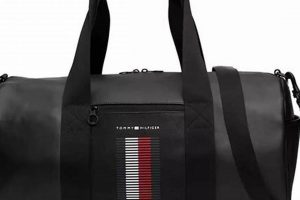
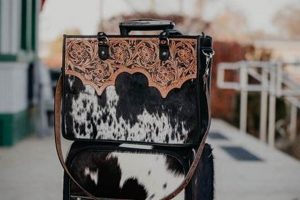
Bags designed for carrying personal belongings during travel that incorporate individual design elements, such as monograms, unique color combinations, or custom graphics, constitute a growing segment of the luggage market. For example, a duffel bag embroidered with a traveler’s initials or a suitcase featuring a family crest would fall under this category. These items transcend mere functionality, offering a medium for self-expression and distinction.
The appeal of customized travel accessories stems from a desire for individuality and ease of identification. These uniquely adorned items reduce the likelihood of confusion or misplacement during transit. Furthermore, the practice of personalizing luggage has historical roots in marking belongings for safety and ownership. Contemporary customization options extend beyond simple identification, providing travelers with an opportunity to reflect their personal style and create memorable travel experiences.
Subsequent discussion will delve into the various methods of creating custom travel carriers, the associated costs and considerations, and the impact of this trend on both the consumer and the luggage manufacturing industry.
Tips for Selecting Personalized Travel Bags
The selection of customized travel carriers requires careful consideration to ensure both aesthetic satisfaction and functional suitability. The following guidance offers insights into making informed decisions regarding the acquisition of uniquely designed luggage.
Tip 1: Assess Material Durability: Prioritize robust materials such as ballistic nylon, reinforced canvas, or high-quality leather to withstand the rigors of travel. Verify the tear strength and abrasion resistance of the chosen material.
Tip 2: Evaluate Customization Method: Different personalization techniques offer varying degrees of longevity and visual impact. Embroidery provides a classic, durable option, while direct printing may offer more intricate designs but potentially reduced lifespan.
Tip 3: Consider Size and Capacity Requirements: Determine the appropriate dimensions and internal volume based on typical travel needs. Oversized bags may incur additional airline fees and present logistical challenges, while undersized options may prove inadequate.
Tip 4: Examine Hardware Quality: Inspect zippers, handles, and buckles for sturdiness and ease of use. Metal hardware generally offers greater durability than plastic alternatives. Ensure smooth zipper operation and secure buckle closures.
Tip 5: Review Personalization Design Proofs: Before final production, meticulously review design proofs to ensure accuracy in spelling, font selection, and color representation. Request revisions as necessary to achieve desired results.
Tip 6: Verify Airline Size and Weight Restrictions: Research specific airline regulations regarding carry-on and checked baggage dimensions and weight limits. Ensure that the chosen bag, even when personalized, complies with these restrictions to avoid potential surcharges or complications.
These considerations promote the selection of customized travel accessories that effectively balance individual expression with practical utility. A well-chosen, uniquely designed bag can enhance travel experiences while providing reliable performance.
The subsequent sections will address maintenance strategies and potential pitfalls associated with owning and using personalized luggage items.
1. Material Durability
The longevity and utility of individualized luggage are intrinsically linked to the selection of robust construction materials. Material durability, therefore, represents a primary determinant of the overall value and lifespan of custom-designed travel accessories.
- Tear Resistance
Tear resistance dictates a material’s ability to withstand ripping or tearing forces, crucial when luggage is subjected to rough handling during transit. Materials like ballistic nylon and ripstop nylon exhibit superior tear resistance compared to standard woven fabrics, minimizing the risk of damage from sharp objects or impacts within baggage handling systems. For personalized travel bags, enhanced tear resistance translates to prolonged use and protection of contents.
- Abrasion Resistance
Abrasion resistance refers to the capacity of a material to resist surface wear caused by rubbing or friction. Luggage frequently encounters abrasive surfaces during airport conveyor belt transport and storage. Materials with high abrasion resistance, such as coated canvas or treated leather, maintain their aesthetic appearance and structural integrity over time, preventing unsightly wear marks and potential weakening of the bag’s construction. Choosing materials with high abrasion resistance maintains the personalized design’s visual appeal for an extended period.
- Water Resistance
Water resistance, or the ability to repel moisture, is a critical factor for safeguarding personal belongings from rain, spills, or damp environments. Materials like waterproof canvas, polyurethane-coated fabrics, and tightly woven synthetics offer varying degrees of water resistance. For personalized travel bags, selecting water-resistant materials protects electronic devices, documents, and clothing from water damage, preserving the bag’s contents and usability. However, consider water-proof travel bags.
- UV Resistance
Prolonged exposure to ultraviolet (UV) radiation from sunlight can degrade certain materials, causing fading, discoloration, and weakening of fibers. Materials with inherent UV resistance or those treated with UV-protective coatings mitigate these effects, preserving the color and structural integrity of personalized travel bags. UV resistance is particularly important for bags frequently used in outdoor environments or stored in direct sunlight.
The cumulative effect of these material properties significantly influences the long-term performance and aesthetic appeal of customized travel gear. Selecting materials that excel in tear, abrasion, water, and UV resistance ensures that personalized travel bags not only reflect individual style but also withstand the demands of frequent travel.
2. Customization Longevity

The enduring visual appeal and identifiable nature of uniquely crafted travel bags are directly proportional to the longevity of the customization method employed. Customization longevity, in this context, refers to the resistance of personalized design elements to fading, peeling, cracking, or other forms of degradation resulting from wear and environmental factors. A compromised customization method negates the primary benefits of personalization, namely easy identification and the expression of individual style. For instance, a travel bag featuring a heat-transferred monogram that peels after minimal use loses its personalized characteristic, diminishing its value and intended purpose. The choice of customization technique, therefore, is paramount in ensuring a durable and visually consistent outcome.
Various customization methods offer varying degrees of longevity. Embroidery, for example, generally provides superior durability compared to screen printing or heat transfer methods. Embroidered designs are directly stitched into the fabric, creating a robust and resilient personalization that withstands frequent use and washing. Conversely, screen-printed or heat-transferred designs are typically applied to the surface of the material, making them more susceptible to cracking, fading, or peeling over time. Selecting a customization method appropriate to the expected usage and environmental conditions is crucial. A bag intended for frequent international travel, subjected to harsh climates and rough handling, necessitates a more durable personalization technique than a bag used primarily for domestic weekend trips.
In summation, customization longevity constitutes a critical factor in the overall value proposition of luggage, as it directly affects the sustained visual integrity and identifying characteristics of items. Improper attention to this consideration can result in premature degradation of customized elements, negating intended benefits. A durable and long-lasting customized design ensures the ongoing value of uniquely identifiable travel bags, while a compromised customization method undermines the entire personalization effort. Selecting a customization option appropriate to usage patterns remains paramount.
3. Size Compliance
Adherence to standardized size regulations constitutes a crucial aspect of ensuring seamless travel with personalized luggage. The term “Size Compliance,” in the context of baggage, denotes the conformity of a bag’s dimensions to limits established by transportation authorities, particularly airlines. Exceeding these limits may result in additional fees, forced gate-checking, or outright rejection of the bag as carry-on luggage. Therefore, selecting or designing individual items that respect size constraints is not merely a matter of convenience but a prerequisite for efficient and cost-effective travel.
- Airline Carry-On Restrictions
Airlines impose strict size limitations on carry-on baggage to ensure overhead compartment capacity and passenger safety. These restrictions, typically expressed in terms of maximum length, width, and height, vary across different airlines and even between flights on the same airline. For personalized luggage, this translates into carefully considering the dimensions of the bag before customization. An otherwise suitable bag, rendered non-compliant due to the addition of oversized external pockets or decorative elements, may incur unexpected charges and inconvenience. Researching the specific carry-on size policies of the intended airline is essential.
- Checked Baggage Limits
While checked baggage generally affords greater size latitude than carry-on luggage, it is also subject to dimensional restrictions. Exceeding these limits, often in addition to weight restrictions, triggers excess baggage fees. Personalizing luggage with robust external frames or bulky additions can inadvertently push a bag beyond allowable dimensions, resulting in avoidable surcharges. Planning the customization process with the airline’s checked baggage size limits in mind can mitigate these risks. This may involve opting for internal organizational features rather than external add-ons.
- Impact of Handles and Wheels
Published size limits for luggage typically include handles and wheels. These components, while essential for portability, can significantly contribute to the overall dimensions of a bag. When selecting a bag for customization, particular attention should be paid to the protrusion of handles and the diameter of wheels. Overly large or poorly designed handles and wheels can easily cause a bag to exceed size restrictions, even if the main compartment itself is within limits. Choosing a bag with streamlined, retractable handles and low-profile wheels is crucial for maintaining size compliance.
- Variations in International Standards
Size limitations for both carry-on and checked baggage vary significantly across international airlines and transportation systems. What is acceptable on a domestic flight in one country may be rejected on an international flight or train journey. Travelers using personalized luggage for international travel must conduct thorough research on the size restrictions applicable to each leg of their itinerary. Failure to do so may result in unforeseen expenses, delays, or the need to abandon cherished personalized items. Opting for a bag with dimensions that conform to the most restrictive international standards provides a degree of universal compliance.
The intricacies of size compliance necessitate careful consideration when selecting and personalizing travel bags. Overlooking these dimensional constraints can lead to financial penalties and logistical challenges. Strategic planning, informed by a thorough understanding of airline policies and international standards, ensures that individualized luggage remains a practical and convenient travel companion.
4. Hardware Quality

The durability and overall functionality of personalized travel bags are significantly influenced by the quality of their constituent hardware. Hardware, in this context, encompasses zippers, buckles, handles, clasps, wheels, and any other metallic or plastic components crucial to the bag’s structural integrity and usability. Inferior hardware compromises the security of the bag’s contents, reduces its lifespan, and detracts from its aesthetic appeal, thereby undermining the value proposition of personalized travel gear. For example, a personalized leather duffel bag with a custom-embroidered design loses its value if the zipper breaks after only a few uses, rendering the bag unusable and negating the investment in personalization.
Consider the specific function of each hardware component. Zippers, responsible for securing the main compartment and various pockets, must be robust and smoothly operational. Buckles and clasps, often used for securing straps or flaps, need to withstand repeated use and exposure to environmental elements. Handles, essential for carrying or maneuvering the bag, must be securely attached and ergonomically designed to prevent strain or discomfort. Wheels, if present, should be durable and capable of rolling smoothly across various surfaces. The failure of any of these components can significantly impede the bag’s functionality and reduce its overall usefulness. A broken handle on a personalized rolling suitcase, for instance, transforms a convenient travel aid into a cumbersome burden, negating the benefits of both the personalization and the rolling design. The selection of high-quality, durable hardware is therefore essential.
In summary, the correlation between “Hardware Quality” and “personalized travel bags” is undeniable. Reliable hardware ensures the longevity, functionality, and aesthetic appeal of uniquely designed travel items. Investing in bags with superior hardware represents a prudent decision, safeguarding against premature wear, ensuring the security of belongings, and preserving the aesthetic integrity of individual customization choices. Failure to prioritize hardware quality diminishes the value and utility of personalized travel gear, ultimately compromising the entire travel experience. The selection of strong hardware, therefore, becomes a core component when buying.
5. Design Accuracy

Design accuracy, in the context of custom travel bags, directly influences the fulfillment of the personalization objective. Deviations from intended design specifications can compromise the aesthetic appeal, functionality, and overall value of the item, rendering the personalization effort ineffective or even counterproductive. Meticulous attention to detail during the design and production phases is therefore paramount in ensuring customer satisfaction and realizing the full potential of individualized travel gear.
- Color Fidelity
Color fidelity refers to the accurate reproduction of colors from the original design to the final product. Inaccurate color representation can significantly alter the intended aesthetic, leading to customer dissatisfaction. For instance, a personalized travel bag designed with specific brand colors may appear unprofessional or inconsistent if the colors are poorly matched during production. This aspect also extends to ensuring color consistency across different materials and printing techniques used on the same bag. Failure to maintain color fidelity undermines the perceived value and brand identity associated with the item.
- Font and Typography Consistency
The accurate rendering of fonts and typography is critical for legibility and maintaining the intended design aesthetic. Incorrect font choices, distorted text, or inconsistencies in letter spacing can detract from the overall visual appeal and compromise the readability of personalized messages or names. A personalized travel bag featuring a distorted or illegible monogram appears unprofessional and diminishes the perceived quality of the item. Maintaining font and typography consistency requires careful attention to detail during the design and production processes.
- Placement and Alignment Precision
Precise placement and alignment of design elements are essential for creating a visually balanced and aesthetically pleasing personalized travel bag. Misaligned logos, off-center monograms, or improperly positioned graphics can create a disjointed and unprofessional appearance. Accurate placement and alignment require careful measurement, precise printing techniques, and quality control measures throughout the production process. The perceived value of a personalized item is significantly reduced when design elements are haphazardly placed or misaligned.
- Image Resolution and Clarity
The resolution and clarity of images incorporated into personalized travel bags directly impact their visual appeal and perceived quality. Low-resolution images or poorly executed printing techniques can result in blurred, pixelated, or distorted visuals, detracting from the overall aesthetic and undermining the personalization effort. High-resolution images and appropriate printing techniques are necessary to ensure sharp, clear, and visually appealing graphics on custom travel bags. The use of low quality images or printing can make the bag appear low value.
These components, collectively, dictate whether the final product mirrors the intended design, ultimately determining customer satisfaction and the successful realization of the personalization objective. Any deviation from these points can lead to low perceived value or even a damaged reputation.
Frequently Asked Questions
This section addresses common inquiries and misconceptions regarding custom luggage options, aiming to provide clarity on their features, benefits, and potential limitations.
Question 1: What are the primary benefits of individualized luggage items beyond aesthetic appeal?
Custom designs significantly reduce the likelihood of misidentification or theft, particularly in crowded transit hubs. Unique designs can also reflect individual style preferences, facilitating self-expression during travel.
Question 2: What materials are most suitable for bespoke travel bags intended for frequent use?
Durable options include ballistic nylon, reinforced canvas, and high-quality leather. These materials offer superior resistance to tearing, abrasion, and water damage, extending the lifespan of the bag.
Question 3: How does the customization method impact the longevity of personalized travel accessories?
Techniques such as embroidery offer greater durability compared to screen printing or heat transfer methods. Embedded designs resist fading, peeling, and cracking, preserving the visual appeal of the bag over time.
Question 4: What factors should be considered when selecting the appropriate size of customized travel bags?
Travelers must adhere to airline regulations regarding carry-on and checked baggage dimensions. Oversized bags may incur additional fees or be rejected altogether. Size compliance is a crucial consideration in selection.
Question 5: How can one ensure that personalized luggage retains its aesthetic appeal over extended periods?
Regular cleaning, proper storage, and avoidance of harsh chemicals are essential. Protecting bags from direct sunlight and extreme temperatures helps prevent fading and material degradation.
Question 6: What recourse is available if the design on personalized baggage is damaged during transit?
In cases of damage attributable to airline handling, passengers should file a claim with the airline immediately upon arrival. Documenting the damage with photographs and retaining all baggage tags and travel documents is advisable.
In summary, customized bags offer practical and aesthetic advantages, provided that careful consideration is given to material selection, customization methods, size compliance, and proper maintenance.
The next section will discuss cost considerations associated with purchasing personalized travel bags.
Conclusion
The preceding analysis has explored various facets of luggage. From material durability to design accuracy, numerous factors influence the utility and value of these items. Individualized luggage offers functional benefits, particularly in terms of ease of identification and a reduction in the risk of misplacement. However, the long-term satisfaction derived from these purchases hinges on careful consideration of the durability of materials, longevity of customization techniques, and compliance with size regulations.
The decision to invest in luggage, therefore, warrants a deliberate and informed approach. Potential purchasers should weigh the advantages of self-expression and enhanced identifiability against the practical considerations of cost, durability, and airline regulations. Ultimately, the selection of individual baggage should align with both personal preferences and the practical demands of travel to ensure a worthwhile investment.
![Top-Rated Best Snowboard Travel Bags: [Year] Gear Guide | Best Travel Tips for Adventurers: Explore the World on a Budget](https://detravellers.com/wp-content/uploads/2026/04/th-173-300x200.jpg "Top-Rated Best Snowboard Travel Bags: [Year] Gear Guide Best Travel Tips for Adventurers: Explore the World on a Budget")