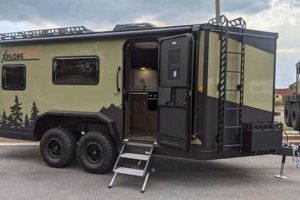
A rugged recreational vehicle designed for traversing unpaved and challenging terrains constitutes a specialized segment within the broader travel trailer market. These robust units are engineered to withstand conditions beyond typical campgrounds, allowing access to remote locations. An example is a trailer equipped with reinforced suspension, all-terrain tires, and a protective undercarriage, enabling safe passage over rocky trails.
The value of these specialized trailers lies in their ability to unlock access to nature’s untouched landscapes. Their durability ensures long-term utility, while their design facilitates self-sufficiency through features like solar power and water storage. Historically, demand for such vehicles has grown as individuals seek more immersive and less conventional outdoor experiences.
The subsequent sections will delve into the key features that define these durable trailers, explore the various types available, and provide guidance on selecting a model that best suits individual needs and intended travel routes.
Essential Considerations for Rugged Terrain Towing
Selecting a recreational vehicle designed for unimproved roads requires careful evaluation. Prioritizing specific features and understanding operational constraints are crucial for a safe and enjoyable experience.
Tip 1: Suspension System Reinforcement: Evaluate the axle and leaf spring configuration. Heavy-duty axles, coupled with multi-leaf or coil-over suspensions, are essential for absorbing impacts and maintaining stability on uneven surfaces. Example: A trailer equipped with a Timbren Axle-Less suspension offers enhanced ground clearance and articulation.
Tip 2: Tire Selection and Ground Clearance: All-terrain or mud-terrain tires with a robust sidewall construction are mandatory. Insufficient ground clearance can lead to undercarriage damage. Aim for a minimum of 15 inches of clearance beneath axles and vital components. Example: BFGoodrich All-Terrain T/A KO2 tires are a popular choice for their durability and off-road performance.
Tip 3: Protective Underbody Shielding: The undercarriage should be protected with steel or aluminum skid plates to safeguard against rocks, branches, and other debris. Shielding critical components, such as water tanks and plumbing, is paramount. Example: Custom-fabricated skid plates offer tailored protection for specific trailer models.
Tip 4: Frame Construction and Weld Quality: The trailer’s frame must withstand significant stress and torsion. Look for a fully boxed frame constructed from high-strength steel, with professional-grade welds at all joints. Example: Finite element analysis can verify the structural integrity of the frame design.
Tip 5: Water Storage and Filtration: Ensure sufficient fresh water capacity for extended stays. A multi-stage water filtration system is necessary to purify water from natural sources. Example: A system incorporating a sediment filter, carbon filter, and UV sterilizer provides comprehensive water treatment.
Tip 6: Power Management and Solar Integration: A robust electrical system, including deep-cycle batteries, an inverter, and a solar charging system, allows for self-sufficient operation. Consider a portable generator as a backup power source. Example: A 200-watt solar panel array can significantly reduce reliance on external power sources.
Tip 7: Weight Distribution and Tow Vehicle Compatibility: Ensure the tow vehicle’s capabilities align with the trailer’s gross vehicle weight rating (GVWR). A weight distribution hitch can improve handling and stability. Example: Consult with a professional hitch installer to determine the appropriate hitch and sway control system.
Prioritizing these factors results in a recreational vehicle better prepared to handle challenging terrains, thus extending travel possibilities and enhancing the overall experience.
The subsequent section will explore specific manufacturers and models that excel in the realm of all-terrain recreational vehicles.
1. Durable Suspension Systems

A robust suspension system is a foundational component of any trailer intended for unimproved road travel. The ability to absorb shocks, maintain tire contact with uneven surfaces, and prevent structural damage directly influences a trailer’s performance and longevity in challenging environments. Inadequate suspension translates to increased stress on the frame, interior components, and towed vehicle, leading to premature failure. A properly engineered system mitigates these risks.
Consider the implementation of independent suspension systems, often incorporating coil springs or air springs with heavy-duty shock absorbers. These designs offer superior wheel articulation compared to traditional leaf spring setups, allowing each wheel to react independently to the terrain. A real-world example is the Australian-designed Cruisemaster ATX suspension, frequently used in premium off-road trailers. Its enhanced travel and damping characteristics significantly improve ride quality and control on corrugated roads and rocky trails. Failure to invest in a durable suspension often results in a compromised towing experience and costly repairs.
The understanding of suspension system importance extends beyond mere component selection. Proper maintenance, including regular inspection of shocks, springs, and bushings, is crucial for sustained performance. Overloading the trailer beyond its specified weight capacity negates the benefits of even the most advanced suspension, exacerbating stress and increasing the likelihood of failure. Therefore, a durable suspension system is not a standalone solution but a critical element within a holistic approach to selecting and maintaining a trailer designed for unimproved road travel.
2. Frame Integrity

Frame integrity represents a cornerstone in the construction of any recreational vehicle intended for traversing unimproved roads. The frame, acting as the structural backbone, absorbs and distributes the dynamic stresses induced by uneven terrain. A deficiency in frame design or construction precipitates catastrophic failures, rendering the trailer unusable and potentially hazardous. The connection between robust frame construction and suitability for off-pavement travel is direct and undeniable. The selection of materials, welding techniques, and overall design contribute to the frame’s ability to withstand torsion, impact, and prolonged vibration. A high-strength steel, fully boxed frame, for example, offers superior resistance to deformation compared to lighter-gauge or partially boxed designs. The consequences of inadequate frame integrity manifest as cracked welds, bent frame members, and separation of the trailer body from the chassis, negating any other beneficial features.
The practical implications of frame integrity extend to the long-term maintainability and resale value. A structurally sound frame provides a stable platform for attaching suspension components, axles, and the trailer body. Ensuring the longevity of these connections reduces the frequency of repairs and associated costs. A trailer exhibiting signs of frame fatigue or prior repairs due to structural weakness commands a lower market price, reflecting the diminished confidence in its continued reliability. Furthermore, specialized testing methods, such as finite element analysis (FEA), can validate the design’s ability to withstand simulated off-road conditions, offering prospective buyers quantifiable assurance of structural performance. Several manufacturers provide detailed specifications on their frame construction, highlighting material types, welding processes, and load-bearing capacities.
In summary, prioritizing frame integrity is not merely a desirable attribute but an essential prerequisite for a durable and capable travel trailer intended for unimproved road use. The investment in a well-designed and constructed frame translates to enhanced safety, reduced maintenance, and improved long-term value. The understanding of these principles allows prospective buyers to critically evaluate trailer specifications and make informed decisions that align with their intended travel environments, ensuring the trailer can withstand the rigors of off-pavement adventures.
3. Ground Clearance

Ground clearance directly dictates a trailer’s ability to navigate uneven and obstructed terrain, establishing it as a fundamental characteristic of any recreational vehicle engineered for unimproved roads. Inadequate clearance results in contact between the trailer’s undercarriage and ground obstacles, leading to potential damage to critical components such as axles, plumbing, holding tanks, and the frame itself. Such damage not only necessitates costly repairs but also compromises the trailer’s structural integrity and operational safety. Therefore, sufficient ground clearance is not merely a desirable attribute, but a critical design parameter. A trailer with high ground clearance allows for greater flexibility in route selection, enabling passage over rocks, ruts, and other obstacles that would impede a trailer with standard dimensions. For example, a trailer designed for traversing the Mojave Desert would require significantly more ground clearance than one intended for maintained forest service roads.
The measurement of ground clearance typically refers to the vertical distance between the lowest point of the trailer’s undercarriage (excluding wheels and tires) and the ground surface. A minimum clearance of 15 inches is generally considered necessary for moderate all-terrain use, while more aggressive off-road applications may necessitate even greater clearance. Achieving adequate ground clearance often requires a combination of factors, including larger diameter tires, suspension lift kits, and careful routing of undercarriage components. Furthermore, the design of the departure angle (the angle between the rear tires and the lowest point of the trailer’s rear) is crucial for preventing damage when descending steep inclines. Manufacturers specializing in off-road trailers often prioritize ground clearance and departure angle optimization, incorporating features such as high-clearance axles and strategically positioned skid plates to protect vulnerable components.
In summary, ground clearance stands as a critical determinant of an off-road recreational vehicle’s capability and durability. Its importance extends beyond mere traversal of obstacles, influencing the trailer’s structural integrity, operational safety, and overall suitability for intended environments. Evaluating ground clearance specifications and understanding the factors that contribute to its effectiveness are essential steps in selecting a trailer that can withstand the rigors of unimproved road travel. The selection process should consider both the intended travel environment and the trailer’s design features to ensure that ground clearance meets the demands of the intended application.
4. Protective Underbody Armor

Protective underbody armor is an indispensable component in the construction of a recreational vehicle designed for unimproved road travel. Undulating terrain and the presence of rocks, branches, and other debris pose a significant threat to vulnerable undercarriage components. Without adequate protection, essential systems such as water tanks, plumbing lines, and electrical wiring are susceptible to damage, potentially leading to system failures and rendering the trailer uninhabitable. The installation of robust shielding directly mitigates these risks, preserving the trailer’s functionality and extending its operational lifespan. Consider, for example, a trailer traversing a rocky trail; without underbody armor, a sharp rock could puncture a water tank, resulting in a loss of water supply and requiring immediate repair. The presence of strategically placed steel or aluminum skid plates prevents such occurrences.
The design and implementation of underbody armor necessitate careful consideration of material selection, thickness, and attachment methods. High-strength steel or aluminum alloys are commonly employed due to their favorable strength-to-weight ratios and resistance to corrosion. The thickness of the armor must be sufficient to withstand the anticipated impacts, while the attachment points must be robust enough to distribute the force of an impact across the frame. Furthermore, the design should allow for access to undercarriage components for maintenance and repairs. An illustration of effective design involves strategically placed skid plates that not only protect the components but also facilitate sliding over obstacles, minimizing the risk of snagging or becoming lodged. Aftermarket suppliers offer a range of pre-fabricated and custom-fabricated underbody armor solutions to address specific trailer models and intended uses.
In conclusion, protective underbody armor constitutes a critical investment for recreational vehicles intended for use on unimproved roads. Its presence directly contributes to the vehicle’s durability, reliability, and overall suitability for challenging environments. The selection and installation of appropriate armor should be viewed as an integral part of the vehicle preparation process, ensuring that critical undercarriage components are adequately shielded from potential damage. By prioritizing this aspect, owners can significantly reduce the risk of costly repairs and enhance their ability to access and enjoy remote destinations with confidence.
5. Tire Quality

Tire quality is paramount for recreational vehicles intended for unimproved road travel. It directly impacts traction, stability, and overall safety. Inadequate tire quality increases the risk of punctures, sidewall damage, and reduced handling, leading to potentially hazardous situations. The relationship between tire quality and overall vehicle performance is deterministic: superior materials and construction yield enhanced durability and performance in challenging terrains.
Selecting appropriate tires necessitates consideration of several factors, including tire type (all-terrain vs. mud-terrain), load rating, ply rating, and sidewall construction. All-terrain tires offer a balance between on-road and off-road performance, while mud-terrain tires prioritize traction in loose or muddy conditions. Higher load and ply ratings indicate greater resistance to punctures and sidewall damage. For instance, BFGoodrich All-Terrain T/A KO2 tires are frequently chosen for their robust construction and proven performance in diverse terrains. Conversely, using standard highway tires on rough terrain invariably results in premature wear and increased risk of failure.
Understanding the importance of tire quality enables informed decision-making, which is crucial in optimizing both safety and functionality. Prioritizing high-quality, appropriately specified tires for an all-terrain recreational vehicle is essential for maximizing performance and minimizing the risk of tire-related incidents. The connection between tire choice and operational safety is a primary consideration when evaluating the suitability of a “best off road travel trailer”. Ignoring this critical element jeopardizes the safety and reliability of the entire system.
6. Water Capacity

Sufficient potable water storage is critical for any recreational vehicle designed for extended self-sufficient operation, particularly those intended for travel in remote areas. The availability of water directly influences the duration and comfort of off-grid excursions, impacting hygiene, sanitation, and overall well-being. Adequate water capacity transforms a trailer from a mere shelter into a functional and independent living space.
- Extended Off-Grid Stays
The primary determinant of remote campsite duration is the onboard water supply. Larger tanks permit longer stays without needing to locate a water source, a significant advantage when traversing arid or sparsely populated regions. For example, a trailer with a 100-gallon capacity supports a couple for approximately one week with conservative usage, while a smaller tank necessitates more frequent resupply.
- Hygiene and Sanitation
Maintaining adequate hygiene in remote locations requires sufficient water. Washing, showering, and sanitation systems (such as composting toilets) consume a considerable amount of water. Limiting water availability compromises sanitation practices, increasing the risk of illness. A well-equipped trailer prioritizes water for sanitation purposes.
- Cooking and Food Preparation
Water is essential for preparing meals, washing dishes, and maintaining food safety. While conservation measures can reduce water usage, an inadequate supply restricts culinary options and potentially compromises food hygiene. The capacity to prepare nutritious meals enhances the overall quality of the travel experience.
- Emergency Preparedness
In unforeseen circumstances, such as unexpected delays or extreme weather conditions, an ample water reserve can prove life-saving. Water scarcity can rapidly become a critical issue in emergency scenarios. A surplus provides a buffer against unexpected events, enhancing safety and self-reliance.
These facets underscore the fundamental role of water capacity in defining a capable off-road recreational vehicle. The ability to store and manage water effectively directly correlates with the vehicle’s suitability for extended and comfortable remote travel. Evaluating water storage options and integrating conservation strategies are essential considerations when selecting a trailer intended for self-sufficient, unimproved road expeditions.
7. Electrical Autonomy

Electrical autonomy, or the ability to operate independently of external power sources, is a defining characteristic of a capable off-road recreational vehicle. Remote locations often lack grid power, making self-sufficiency paramount. A trailer devoid of robust electrical capabilities severely restricts the functionality of onboard appliances, lighting, and essential systems. This limitation directly impacts comfort, convenience, and safety, compromising the ability to undertake extended journeys into unimproved areas. A practical example is the inability to operate a refrigerator for preserving food or utilize lighting for safety and visibility during nighttime hours. Electrical autonomy, therefore, is not merely an amenity but a foundational requirement for an effective off-road trailer.
Achieving electrical autonomy typically involves a combination of components, including solar panels, deep-cycle batteries, inverters, and a generator as a backup. Solar panels harness sunlight to replenish battery reserves, enabling sustainable power generation in sunny conditions. Deep-cycle batteries provide stored energy for powering appliances and lighting. An inverter converts direct current (DC) from the batteries to alternating current (AC) for operating standard household devices. The presence of these systems allows for powering refrigerators, cooking appliances, water pumps, and electronic devices without reliance on external power hookups. The absence of one or more of these components can significantly limit the practical applications of such a trailer.
In summary, electrical autonomy is an indispensable attribute for a recreational vehicle designed for unimproved road travel. The investment in robust electrical systems translates to greater self-sufficiency, enhanced comfort, and improved safety in remote environments. The understanding and prioritization of electrical autonomy are crucial factors in selecting a trailer that can effectively support extended off-grid adventures, fully embracing the potential of a “best off road travel trailer.” Challenges to this include cost and system maintenance, but the benefits justify the consideration for many users.
Frequently Asked Questions About Rugged Terrain Travel Trailers
This section addresses common inquiries regarding recreational vehicles designed for use on unimproved roads. The information aims to clarify key aspects and dispel potential misconceptions.
Question 1: What distinguishes a robust terrain travel trailer from a standard model?
Units intended for challenging terrains incorporate reinforced suspension systems, all-terrain tires, protective underbody armor, and a robust frame construction designed to withstand greater stress. Standard models typically lack these features.
Question 2: Is a specialized tow vehicle mandatory?
A tow vehicle with adequate towing capacity, appropriate ground clearance, and a suitable hitch system is essential. While a four-wheel-drive vehicle is beneficial, it is not always strictly necessary depending on the intended terrain.
Question 3: How important is ground clearance?
Ground clearance is critical. Insufficient clearance leads to undercarriage damage from rocks and obstacles. A minimum of 15 inches is generally recommended for moderate all-terrain use.
Question 4: What role does suspension play?
The suspension system absorbs impacts and maintains tire contact, ensuring stability and preventing frame damage. Heavy-duty axles, coil springs, or air springs are preferable to standard leaf spring configurations.
Question 5: Can solar power be integrated?
Solar power integration offers significant advantages by providing a renewable energy source for powering appliances and reducing reliance on generators. The feasibility depends on available roof space and energy consumption needs.
Question 6: What maintenance considerations exist?
Regular inspection of suspension components, tires, and underbody armor is essential. Lubrication of moving parts and prompt repair of any damage will prolong the trailer’s lifespan.
The preceding responses highlight key considerations for individuals evaluating or operating all-terrain recreational vehicles. Proper understanding and adherence to these principles are crucial for safe and successful expeditions.
The subsequent section will provide guidance on selecting the most appropriate model based on individual requirements and intended travel environments.
Conclusion
This exploration of the best off road travel trailer has underscored the critical attributes that define a capable and reliable vehicle for unimproved road travel. The frame integrity, suspension system, ground clearance, tire quality, underbody protection, water capacity, and electrical autonomy have emerged as key determinants of a trailer’s suitability for challenging environments. Evaluating these factors meticulously ensures a safe and enjoyable experience.
The selection of an all-terrain recreational vehicle demands a thorough assessment of individual needs and intended travel routes. Prioritizing durability, functionality, and self-sufficiency will unlock access to remote landscapes and create lasting memories. Understanding these principles will empower informed decisions, maximizing the potential of these exceptional vehicles.