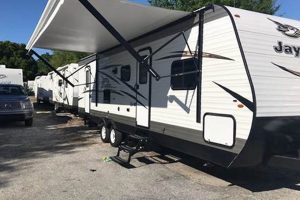
The process of elevating a recreational vehicle using a mechanical device is fundamental for maintenance, tire changes, and ensuring stability on uneven terrain. This task involves the strategic placement and operation of jacks to lift the trailer’s frame or axle, allowing for necessary repairs or adjustments. A common example would be raising the trailer to replace a flat tire or to install leveling blocks when parked on an unlevel campsite.
Performing this procedure correctly is crucial for the safety of both the individual and the equipment. It provides access to the undercarriage for essential inspections and repairs, preventing further damage and potentially costly breakdowns. Historically, this practice has evolved from using simple wooden blocks to sophisticated hydraulic and electric systems, reflecting advancements in engineering and the increasing complexity of recreational vehicles.
The following sections will detail the equipment required, safety precautions to observe, and the step-by-step instructions to execute this process safely and effectively, ensuring the longevity and reliability of the travel trailer.
Essential Considerations for Travel Trailer Elevation
The following guidelines provide critical information to ensure a secure and successful travel trailer lifting operation.
Tip 1: Selection of Appropriate Equipment: Employ a jack rated to handle the weight of the trailer. Refer to the trailer’s Gross Vehicle Weight Rating (GVWR) and select a jack with a sufficient load capacity. Utilize jack stands for added safety, positioning them adjacent to the jack once the trailer is elevated.
Tip 2: Surface Preparation: Ensure the ground surface is firm and level. If the ground is soft, use a solid base plate or wooden block beneath the jack to distribute the load and prevent sinking. Avoid loose gravel or excessively muddy areas.
Tip 3: Pre-Lifting Inspection: Before lifting, thoroughly inspect the trailer frame for any signs of damage or corrosion. Avoid jacking on compromised areas, as this could lead to structural failure. Identify designated jacking points as indicated by the manufacturer.
Tip 4: Wheel Chocking: Prior to any lifting operation, securely chock the wheels on the opposite side of the trailer to prevent movement. This measure is paramount for maintaining stability and preventing accidental rolling.
Tip 5: Controlled Elevation: Lift the trailer slowly and deliberately, maintaining constant observation for any signs of instability or shifting. Avoid sudden or jerky movements that could compromise the integrity of the lifting process.
Tip 6: Jack Stand Placement: Once the desired height is achieved, immediately position jack stands beneath the trailer frame at designated support points. Ensure the jack stands are securely locked into position and adequately support the load before commencing any work.
These essential considerations are designed to promote safety and minimize the risk of damage during travel trailer elevation. Adherence to these guidelines will contribute to a secure and efficient operation.
Subsequent sections will explore more advanced techniques and troubleshooting tips for maintaining and leveling travel trailers.
1. Preparation

Prior to any attempt to elevate a travel trailer, a meticulous preparation phase is paramount. This groundwork dictates the safety, efficiency, and ultimate success of the lifting operation. Insufficient preparation can lead to equipment failure, personal injury, or damage to the trailer itself.
- Site Assessment and Stabilization
The terrain where the elevation will occur must be carefully assessed. Uneven or soft ground can compromise the stability of the jack. Ensuring a firm, level surface is critical. This may necessitate the use of leveling boards or shims to create a stable base for the jack and jack stands. Failure to address ground conditions can result in the jack sinking or shifting during the lifting process, creating a hazardous situation.
- Equipment Inspection and Readiness
A thorough examination of all equipment intended for use, including the jack, jack stands, and any associated tools, is essential. Verify that the jack possesses the appropriate weight rating for the travel trailer. Inspect for any signs of damage or wear, such as cracks, leaks, or corrosion. Ensure that jack stands are in good working order and can securely lock into position. Having the proper tools readily available, such as a lug wrench, wheel chocks, and safety glasses, streamlines the process and minimizes potential delays.
- Trailer Assessment and Component Identification
A comprehensive inspection of the travel trailer itself is necessary to identify suitable jacking points and assess the structural integrity of the frame. Consult the trailer’s manual for recommended jacking locations. Check for any signs of rust, damage, or weakened areas near the intended jacking points. Understanding the location of vital components, such as axles and suspension systems, is critical to avoid damaging them during the lifting procedure.
- Implementation of Safety Protocols
Prior to commencing the lifting operation, implement comprehensive safety measures. Securely chock the wheels opposite the jacking point to prevent any unintended movement of the trailer. Ensure that the trailer is disconnected from any external power sources or utilities. Clear the area of any obstructions or bystanders. Wear appropriate personal protective equipment, such as safety glasses and gloves. A clear understanding of emergency procedures, including how to safely lower the trailer in the event of a jack failure, is crucial.
These four facets of preparation are not isolated steps but rather interconnected elements that collectively contribute to a safe and successful outcome. Neglecting any of these aspects increases the risk of accidents and potential damage. Thorough preparation is not merely a recommendation but a fundamental prerequisite for responsibly and effectively elevating a travel trailer.
2. Equipment Selection
The choice of equipment is foundational to the safe and effective execution of travel trailer elevation procedures. Selecting the correct tools directly impacts the stability of the lift, the prevention of damage to the trailer, and the overall safety of the individual performing the task.
- Jack Capacity and Type
The jack’s rated lifting capacity must exceed the portion of the trailer’s weight it will support during the lifting operation. Scissor jacks, bottle jacks, and hydraulic jacks are common options, each possessing distinct advantages and disadvantages. A scissor jack is often compact and suitable for lighter trailers, while a bottle jack provides greater lifting power for heavier models. Hydraulic jacks offer a smoother, more controlled lift. The selection hinges on matching the jack’s capabilities to the trailer’s weight and the terrain’s conditions.
- Jack Stands: Load Rating and Stability
Jack stands provide crucial secondary support once the trailer is elevated. Their load rating must also exceed the supported weight. Look for stands with a wide base for enhanced stability and adjustable height settings to accommodate varying lift requirements. The stands must be placed on a solid, level surface to prevent tipping or shifting under load. The number of jack stands used should correspond to the size and weight of the trailer, ensuring adequate support across the frame.
- Wheel Chocks: Material and Placement
Wheel chocks prevent unintended movement of the trailer during the lifting process. They are typically made of rubber, plastic, or metal and should be sized appropriately for the trailer’s tires. Placement is critical; chocks should be firmly positioned against the tires on the axle opposite the lifting point. Multiple chocks may be necessary for added security, especially on uneven terrain. Inspect chocks for wear or damage before each use, as compromised chocks offer reduced effectiveness.
- Auxiliary Tools and Safety Gear
Beyond the primary lifting and support equipment, a range of auxiliary tools enhances safety and efficiency. These may include a torque wrench for properly tightening lug nuts after a tire change, leveling blocks to create a stable base for the jack, and work gloves to protect hands. Safety glasses are essential to protect against debris. Having these tools readily available streamlines the process and minimizes the risk of injury.
In summation, appropriate equipment selection directly determines the viability and safety of elevating a travel trailer. Matching tool capabilities to the trailer’s specifications and environmental conditions is paramount. Utilizing quality equipment, combined with adherence to safety protocols, minimizes risks and ensures a successful operation.
3. Jacking Points
The selection and utilization of appropriate jacking points are intrinsic to the successful and safe execution of recreational vehicle elevation. Jacking points are specifically engineered locations on the trailer’s frame designed to withstand the concentrated force exerted by a jack during lifting. The cause-and-effect relationship is direct: incorrect jacking point selection can cause significant structural damage to the trailer frame, suspension system, or other critical components. A real-life example involves attempting to lift a trailer by the underbelly, which is not reinforced and would likely result in deformation or puncture. Conversely, employing the designated jacking points distributes the load appropriately, mitigating stress and minimizing the risk of damage. Thus, identifying and adhering to manufacturer-specified jacking locations is a non-negotiable aspect of the “how to jack up a travel trailer” process.
The practical significance of understanding correct jacking points extends beyond preventing structural damage. It directly impacts the stability of the lifted trailer. Lifting from a non-designated location can induce instability, increasing the risk of the trailer slipping off the jack or jack stands. This is especially true on uneven ground or in windy conditions. Proper jacking point utilization, coupled with the use of jack stands, provides a stable and secure platform for performing maintenance tasks such as tire changes, brake inspections, or wheel bearing lubrication. Ignoring this critical step can lead to serious accidents and injuries.
In conclusion, the correct identification and utilization of designated jacking points represent a fundamental aspect of safely and effectively elevating a recreational vehicle. Deviating from manufacturer recommendations poses a significant risk of structural damage and personal injury. The importance of this knowledge cannot be overstated, as it forms the cornerstone of responsible trailer maintenance and ensures the longevity and safety of both the equipment and the individual performing the task. While seemingly a simple step, it is the linchpin of a successful and damage-free lifting operation.
4. Safety Measures

The implementation of rigorous safety measures is paramount during any travel trailer lifting operation. Neglecting these precautions significantly elevates the risk of equipment damage, personal injury, or even fatal accidents. The following facets outline essential safety protocols that must be adhered to during the entire process.
- Wheel Chocking and Stabilization
The primary safety measure involves immobilizing the trailer prior to lifting. Wheel chocks, constructed of durable materials, must be firmly placed against the tires on the axle opposite the jacking point. This prevents unintended rolling, which can destabilize the jack and cause the trailer to fall. Real-world examples include trailers shifting unexpectedly on inclines, leading to catastrophic failures. Proper chocking is the first line of defense against such incidents.
- Jack Stand Placement and Load Distribution
Jack stands serve as a crucial backup support system. Once the trailer is elevated, jack stands rated for the appropriate weight must be positioned beneath the frame at designated support points. The stands should be placed on a solid, level surface to ensure even load distribution. Failure to use jack stands, or using stands with insufficient capacity, can result in the trailer collapsing, potentially causing severe injuries. Regular inspection of jack stands for damage is also essential.
- Personal Protective Equipment (PPE)
Individuals involved in trailer lifting must wear appropriate personal protective equipment. Safety glasses protect against flying debris, such as rust or metal fragments, which can cause eye injuries. Work gloves provide a secure grip and protect hands from abrasions or cuts. Appropriate footwear is also necessary to prevent slips and falls. The use of PPE minimizes the risk of preventable injuries during the operation.
- Clear Communication and Exclusion Zone
Effective communication is crucial when multiple individuals are involved in the lifting process. Establish clear signals and procedures to avoid misunderstandings that could lead to accidents. A designated exclusion zone should be established around the trailer to prevent bystanders from entering the area while the trailer is elevated. This prevents accidental contact with the trailer or equipment, reducing the risk of injury.
These safety measures are not merely suggestions, but rather essential protocols that must be strictly followed. They represent the difference between a successful and safe operation and a potentially devastating accident. Diligent adherence to these guidelines ensures the well-being of all involved and protects the integrity of the travel trailer.
5. Controlled Ascent

The term “controlled ascent” denotes the deliberate and gradual elevation of a travel trailer during the jacking process. It is not merely lifting the trailer, but rather a process demanding precision and vigilance to mitigate risk. The speed and smoothness of the ascent directly influence the stability of the trailer and the safety of the operation. A controlled ascent ensures that stresses are distributed evenly, reducing the likelihood of equipment failure or structural damage.
- Incremental Lifting and Pauses
A controlled ascent involves lifting the trailer in small, manageable increments, followed by brief pauses. This allows for inspection of the jack, jack stands, and the trailer frame for any signs of stress or instability. Real-world instances reveal that sudden or rapid lifting can overload components, leading to bending, cracking, or complete failure. Pausing provides the opportunity to make necessary adjustments and prevent further escalation of potential problems.
- Constant Monitoring of Stability
During the ascent, continuous monitoring of the trailer’s stability is crucial. This involves observing the trailer for any signs of tilting, swaying, or shifting. The operator must also listen for unusual noises, such as creaking or groaning, which may indicate excessive stress on the frame. Any observed instability necessitates immediate cessation of the lifting process and a thorough assessment of the situation before proceeding.
- Synchronization of Lifting Points
For larger travel trailers that require multiple jacks, synchronization of the lifting points is essential. Each jack must be raised in a coordinated manner to maintain a level lifting plane. Uneven lifting can induce torsional stress on the trailer frame, potentially causing permanent damage. The operator must communicate effectively and use leveling tools to ensure that all lifting points are raised at the same rate.
- Avoiding Over-Extension of Jacks
Exceeding the maximum extension range of a jack compromises its stability and load-bearing capacity. A controlled ascent ensures that the jack is operated within its designed limits. If additional height is required, shims or blocks should be used to extend the reach of the jack, rather than over-extending the jack itself. This prevents the jack from becoming unstable and potentially collapsing under the weight of the trailer.
In summary, a controlled ascent is not merely a procedural step, but a philosophy of careful execution when elevating a travel trailer. It encompasses incremental lifting, constant monitoring, synchronized action, and adherence to equipment limitations. This approach significantly enhances safety, minimizes the risk of damage, and ensures a successful outcome when jacking up a travel trailer.
6. Secure Support

The phase of securing the elevated travel trailer constitutes a critical stage within the overall procedure of lifting it. Achieving stable support post-elevation is not merely an ancillary step; it represents the culmination of careful preparation and execution. The absence of secure support immediately transforms a controlled lifting operation into an inherently hazardous scenario. Real-world incidents, such as a trailer collapsing due to inadequate jack stand placement, underscore the potentially devastating consequences of neglecting this vital aspect. Secure support, therefore, is not an option but an essential requirement, acting as the last line of defense against instability and potential structural failure of the trailer.
The practical application of secure support manifests primarily through the strategic placement and correct usage of jack stands. These stands, selected with the appropriate weight rating and designed for stability, are positioned beneath the trailer frame at designated support points. It is critical to ensure that the stands rest on a firm, level surface to prevent shifting or sinking under load. The number of stands deployed must be commensurate with the size and weight of the trailer, providing distributed support to prevent localized stress concentrations. Regular inspection of the stands for damage, such as cracks or corrosion, is also paramount to guarantee their load-bearing integrity. Incorrect placement or damaged equipment negates the intended safety benefits, rendering the entire lifting process suspect.
In summation, secure support is an indispensable component within the broader context of elevating a travel trailer. The implementation of robust support measures, predicated on appropriate equipment and diligent execution, is not a matter of convenience but a prerequisite for ensuring safety and preventing damage. While various challenges, such as uneven terrain or equipment limitations, may complicate the process, the fundamental principle remains constant: the integrity of the entire operation hinges on the establishment of secure and reliable support for the elevated trailer.
Frequently Asked Questions
This section addresses common inquiries regarding the proper methods and safety precautions associated with elevating a travel trailer.
Question 1: Is it permissible to elevate a travel trailer by its axle?
Elevating a trailer by its axle is generally discouraged unless explicitly recommended by the manufacturer. While seemingly convenient, this practice can potentially damage the axle, suspension components, or braking system. Always consult the trailer’s documentation for designated jacking points on the frame.
Question 2: What constitutes an adequate weight rating for a jack intended for travel trailer elevation?
The jack’s weight rating must exceed the anticipated load it will bear. Determine the Gross Vehicle Weight Rating (GVWR) of the trailer, then select a jack with a capacity that surpasses the weight distributed on the side being lifted. A margin of safety is advisable to account for uneven weight distribution or unforeseen circumstances.
Question 3: Are jack stands unequivocally necessary, or can the jack alone suffice during brief maintenance procedures?
Jack stands are non-negotiable safety equipment. Relying solely on the jack, even for momentary tasks, is imprudent. Jacks can fail unexpectedly, leading to rapid trailer descent and potential injury or equipment damage. Jack stands provide a crucial secondary support system.
Question 4: How frequently should travel trailer owners inspect their jacking equipment for signs of wear or damage?
A comprehensive inspection of all jacking equipment, including the jack itself, jack stands, and wheel chocks, should be conducted prior to each use. Examine for cracks, corrosion, leaks, or any other indications of compromise. Damaged or worn equipment must be replaced immediately to ensure safety.
Question 5: What alternatives exist for stabilizing a travel trailer on particularly uneven terrain during the lifting process?
On uneven surfaces, employ leveling blocks or boards beneath the jack and jack stands to create a stable and level base. Distribute the weight evenly to prevent the jack or stands from sinking into soft ground. In extreme cases, consider relocating the trailer to a more suitable location before attempting elevation.
Question 6: Does disconnecting the travel trailer from its towing vehicle influence the stability during elevation?
Disconnecting the trailer from the towing vehicle is generally recommended to prevent unintended movement or transfer of forces. Ensure the trailer is level and stable before disconnecting, and chock the wheels to prevent rolling. This isolation minimizes the risk of the towing vehicle affecting the lifting process.
Proper execution of recreational vehicle elevation requires meticulous attention to detail and strict adherence to safety protocols. The information provided here serves as a guideline; always consult the trailer manufacturer’s recommendations for specific procedures.
Further exploration of troubleshooting techniques and advanced leveling methods will be addressed in subsequent discussions.
How to Jack Up a Travel Trailer
The preceding sections have methodically detailed the process of elevating a travel trailer, underscoring the critical aspects of preparation, equipment selection, proper jacking point identification, rigorous safety measures, controlled ascent techniques, and secure support implementation. Each element contributes directly to the overall safety and efficacy of the procedure, mitigating the inherent risks associated with lifting a heavy object.
Mastery of these techniques is essential for responsible travel trailer ownership. Continued diligence in adhering to recommended procedures and prioritizing safety will ensure the longevity of the trailer and the well-being of those involved in its maintenance. The principles outlined should serve as a foundation for informed decision-making in all travel trailer elevation scenarios, reinforcing the commitment to safety and responsible operation.


![Best Travel Trailer Toy Hauler Floor Plans: [Year] Guide! | Best Travel Tips for Adventurers: Explore the World on a Budget](https://detravellers.com/wp-content/uploads/2026/05/th-140-300x200.jpg "Best Travel Trailer Toy Hauler Floor Plans: [Year] Guide! Best Travel Tips for Adventurers: Explore the World on a Budget")