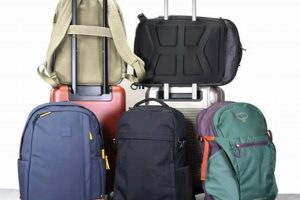
A specialized carrying case designed to protect and transport a child’s car seat during travel represents a valuable asset for families. These bags, often constructed from durable, water-resistant materials, safeguard the car seat from damage, dirt, and wear and tear encountered during air travel, cruises, or other journeys. Examples range from simple, budget-friendly models with basic padding to more elaborate designs featuring wheels, backpack straps, and additional storage compartments.
The utilization of such protective measures offers numerous advantages. It mitigates the risk of damage to the car seat, potentially saving replacement costs. The cleanliness of the car seat is maintained, ensuring a more hygienic environment for the child. Furthermore, some models streamline the transport process, reducing the burden on the traveler. Historically, families resorted to cumbersome methods of carrying car seats, but the introduction of these bags has significantly enhanced convenience and protection.
The following sections will delve into the key features to consider when selecting a suitable option, explore the diverse types available on the market, and provide guidance on proper usage and maintenance to ensure optimal protection and longevity.
Essential Guidance for Selecting and Utilizing Protective Car Seat Carriers
Proper selection and use of a protective carrier for car seats are crucial for ensuring both the safety of the child’s seating device and convenience during travel. The following tips provide guidance on maximizing the benefits of these products.
Tip 1: Prioritize Durability: Evaluate the material and construction of the bag. Opt for models constructed from heavy-duty, water-resistant fabrics like ballistic nylon or reinforced polyester to withstand the rigors of travel. Examine the stitching and zipper quality for added reinforcement.
Tip 2: Assess Size and Compatibility: Confirm that the chosen bag is appropriately sized for the specific car seat model. Consult the car seat manufacturer’s specifications and product dimensions to ensure a proper fit. Overly tight or loose fits can compromise protection.
Tip 3: Consider Portability Features: Evaluate the available transport options. Bags equipped with wheels and padded handles offer enhanced maneuverability, particularly in airport environments. Backpack-style models provide hands-free carrying, distributing weight more evenly.
Tip 4: Examine Padding and Protection: Inspect the level of internal padding offered. Adequate cushioning is essential for protecting the car seat from impacts and abrasion during transit. Reinforcement in key areas, such as the headrest and sides, provides added security.
Tip 5: Investigate Storage Capacity: Some bags include additional pockets or compartments for storing related items, such as blankets, toys, or travel accessories. Consider the need for extra storage space based on individual travel requirements.
Tip 6: Evaluate Closure Mechanisms: Zipper quality and security are paramount. Opt for heavy-duty zippers with reinforced seams to prevent breakage or accidental opening during transport. Consider models with locking mechanisms for added security.
Tip 7: Practice Proper Packing Techniques: When packing the car seat into the bag, ensure that all straps and buckles are secured and tucked away to prevent damage. Utilize additional padding or cushioning if necessary to fill any gaps and provide extra protection.
Selecting and utilizing appropriate protective carriers can safeguard the integrity of the car seat, simplify the travel process, and provide peace of mind. Diligent adherence to these guidelines will optimize the benefits associated with the product.
The next section will discuss maintenance guidelines for optimal performance.
1. Durability

Durability, in the context of a car seat travel bag, directly impacts its ability to safeguard the enclosed car seat from the rigors of travel. The intended function of such a bag is to shield the car seat from physical damage, dirt, and the general wear and tear associated with handling by transportation services. Inferior materials or construction methods inevitably lead to premature failure of the bag, exposing the car seat to potential harm. For example, a bag constructed with weak stitching or thin fabric is susceptible to tearing during transit, negating its protective purpose.
The correlation between a car seat travel bag’s structural integrity and its protective capability is paramount. A robust design, incorporating reinforced seams, heavy-duty zippers, and abrasion-resistant materials, ensures the bag withstands impacts, dragging, and exposure to varying environmental conditions. Bags lacking these durable elements are more likely to sustain damage, potentially compromising the car seat within. The additional expense for a higher-quality, more durable bag often represents a sound investment, mitigating the risk of damage to a significantly more costly car seat.
Therefore, durability is not merely a desirable attribute but a fundamental requirement for a car seat travel bag to effectively fulfill its intended purpose. The long-term utility and cost-effectiveness of the bag are directly proportional to its ability to endure the demands of frequent travel without succumbing to structural failure, thereby safeguarding the contained car seat.
2. Compatibility

Compatibility, as a characteristic of a car seat travel bag, is inextricably linked to its practical effectiveness. The primary function of such a bag is to protect a specific car seat during transit. If the bag’s dimensions and design are not adequately matched to the car seat’s size and shape, the protective function is compromised. A bag too small will be unusable. A bag too large allows the car seat to shift excessively during transport, increasing the risk of damage from impacts. Therefore, the concept of ‘best’ in the context of car seat travel bags is inherently tied to its capacity to accommodate the target car seat securely.
The implications of incompatibility extend beyond mere inconvenience. Inadequate fit can lead to stress on the bag’s seams and zippers, accelerating wear and tear, ultimately reducing the bag’s lifespan. Furthermore, an ill-fitting bag may not provide sufficient cushioning or protection to vulnerable parts of the car seat, such as the headrest or side-impact protection features. A common example is attempting to use a universal-sized bag with a particularly large or unusually shaped infant car seat; this often results in a struggle to close the bag securely and a lack of adequate padding in critical areas. This highlights the significance of meticulously verifying compatibility before purchase.
In summary, compatibility is a foundational element in determining the suitability of a car seat travel bag. Its absence negates the bag’s protective purpose and can lead to both inconvenience and potential damage to the car seat itself. Selecting a bag requires careful attention to manufacturer specifications and, ideally, verification through direct comparison, ensuring the bag effectively fulfills its protective function throughout the travel process. This understanding directly informs the selection of a truly ‘best’ option.
3. Portability

Portability is a critical attribute of a car seat travel bag, directly influencing its usability and the ease with which travelers can transport a child’s car seat. The convenience afforded by a well-designed, portable bag is a significant factor in determining its overall value and suitability for travel.
- Weight and Balance
The weight of the bag, both when empty and when containing a car seat, is a primary consideration. Lighter materials and optimized design contribute to reduced strain on the traveler. Balanced weight distribution prevents awkward carrying positions that can lead to fatigue or injury. For example, a bag with an uneven weight distribution may cause the carrier to lean to one side, increasing the effort required for transport and raising the risk of dropping the bag.
- Handle Design and Placement
The design and placement of handles directly impact the ease of carrying. Ergonomically designed handles, preferably padded, minimize hand fatigue. Multiple handle options, such as top and side handles, allow for versatile carrying positions depending on the situation. Poorly placed or uncomfortable handles can significantly hinder maneuverability, especially in crowded environments like airports. An example would be a bag with thin, unpadded handles that dig into the carrier’s hands, making it difficult to transport the car seat over extended distances.
- Wheels and Rolling Mechanism
The inclusion of wheels can significantly enhance portability, transforming the bag from a carried item to a rolling one. The quality of the wheels and the smoothness of the rolling mechanism are crucial. Durable wheels that can navigate various surfaces, such as carpet and pavement, are essential. A smooth rolling action minimizes effort and prevents the bag from snagging or tipping over. Low-quality wheels that are prone to sticking or breaking can render the rolling function ineffective, forcing the traveler to carry the bag instead.
- Backpack Straps and Harness System
Backpack-style carrying systems offer hands-free portability, distributing the weight of the car seat across the shoulders and back. Padded straps, adjustable torso lengths, and chest or hip belts contribute to a comfortable and secure fit. An effective harness system prevents the bag from shifting excessively during movement, maintaining balance and reducing strain. A bag with poorly designed backpack straps may cause discomfort and instability, making it unsuitable for longer periods of carrying.
These facets of portability collectively determine the ease and comfort with which a car seat can be transported using a travel bag. The “best car seat travel bag” prioritizes these elements, offering a design that minimizes physical strain and maximizes convenience for the traveler.
4. Protection

The primary function of a car seat travel bag is to safeguard the enclosed car seat from potential damage during transit. Protection, therefore, represents a core element in defining the “best car seat travel bag”. The level of protection offered directly correlates with the bag’s ability to prevent impacts, scratches, tears, and general wear and tear that can compromise the structural integrity and safety features of the car seat. For instance, baggage handlers at airports subject luggage to considerable forces; without adequate protection, a car seat’s plastic shell could crack, or its foam padding could be compressed, rendering it less effective in the event of a collision. A bag with insufficient padding provides minimal defense against these hazards.
Effective protection stems from a combination of durable materials and thoughtful design. Heavy-duty fabrics, reinforced seams, and strategically placed padding are essential. Certain bags incorporate features such as rigid frames or impact-absorbing panels to further enhance protection. The absence of these features increases the likelihood of damage to the car seat. Consider a scenario where a car seat is placed on a luggage carousel without sufficient protection; its fabric covering could easily be torn by protruding edges or abrasive surfaces, resulting in cosmetic damage or, more critically, compromising the integrity of the harness system. The practical significance of this understanding lies in recognizing that a seemingly minor tear could ultimately impact the car seat’s performance in a real-world accident.
In conclusion, the connection between protection and the “best car seat travel bag” is not merely incidental but foundational. The degree to which a bag shields a car seat from damage directly influences the car seat’s continued safety and functionality. Selecting a car seat travel bag that prioritizes robust construction and comprehensive protective features is paramount, ensuring the child restraint system remains effective for its intended purpose. This understanding highlights the crucial role a quality travel bag plays in maintaining child passenger safety during travel.
5. Size

The dimension of a car seat travel bag directly determines its suitability for enclosing and protecting a specific car seat model. Size is a critical determinant of whether the bag can effectively serve its purpose; it is therefore inextricably linked to the concept of the “best car seat travel bag.” An improperly sized bag, either too small or too large, compromises the bag’s protective function and ease of transport. A bag that is too small will not accommodate the car seat, rendering it unusable. Conversely, an excessively large bag permits the car seat to shift during handling, increasing the risk of impact damage. Real-world examples include families attempting to fit a convertible car seat into a standard infant car seat travel bag, resulting in either inability to close the bag or undue stress on the zipper seams. The practical significance of understanding proper sizing lies in the prevention of damage and the enhancement of transport convenience.
The interior dimensions of a travel bag should be several inches larger than the car seat’s exterior dimensions to allow for easy insertion and removal, while still providing a snug fit to minimize movement during handling. The bag’s exterior dimensions also influence its ease of handling at airports or in vehicles. An excessively large and bulky bag may be difficult to maneuver through security checkpoints or fit into overhead compartments on airplanes. Conversely, a smaller, more compact bag may be easier to manage but could compromise the level of protection offered. Many car seat and travel bag manufacturers provide detailed sizing charts to assist consumers in selecting the appropriate bag for their specific car seat model, but these charts should always be carefully reviewed and verified before purchase. Moreover, additional space might be necessary if intending to pack extra padding like blankets to provide more protection.
In summary, the size of a car seat travel bag is a critical factor influencing its overall effectiveness and usability. Choosing a bag with dimensions that precisely match the car seat’s requirements is essential to ensure adequate protection during transit and facilitate ease of handling. Disregarding the size considerations can lead to damage to the car seat, inconvenience during travel, and ultimately, a failure of the bag to fulfill its intended purpose. The “best car seat travel bag” therefore prioritizes appropriate dimensions, reflecting a balance between providing ample protection and maintaining manageable size for transport.
6. Features

The presence and quality of specific features significantly impact the functionality and overall utility of a car seat travel bag, directly influencing its designation as a “best car seat travel bag.” These features extend beyond basic construction, encompassing elements that enhance protection, portability, and convenience. The absence of critical features can render a bag less effective in safeguarding the car seat or more difficult to manage during travel. For instance, a bag lacking reinforced seams is more susceptible to tearing under stress, diminishing its protective capability. The cause-and-effect relationship is evident: superior features contribute to enhanced performance, while their absence detracts from it. Understanding these nuances is crucial in selecting a product that effectively meets travel needs.
Specific examples of crucial features include padded interiors, which provide cushioning against impacts; durable wheels, which facilitate easy transport through airports; and backpack-style straps, which offer hands-free carrying options. Additional desirable features may include water-resistant materials, internal pockets for storing accessories, and identification card slots for easy retrieval in case of loss. The practical significance of these features becomes apparent in real-world scenarios, such as navigating crowded airports or protecting the car seat from inclement weather. A bag equipped with these elements offers a considerable advantage over a basic model, justifying the higher investment. Moreover, features catering to ease of use, like dual zippers or wide openings, streamline the process of packing and unpacking the car seat, saving time and effort.
In summary, features are an indispensable component of a “best car seat travel bag,” directly affecting its protective capability, portability, and user convenience. The selection process should involve careful consideration of these elements, prioritizing those that align with individual travel needs and preferences. While a bag with numerous features may come at a higher price point, the enhanced functionality and peace of mind it provides often outweigh the additional cost. Ultimately, the “best car seat travel bag” is one that incorporates well-designed features to optimize the travel experience while ensuring the safety and integrity of the car seat.
Frequently Asked Questions
The following addresses common inquiries and concerns regarding car seat travel bags, providing essential information for informed decision-making.
Question 1: What is the primary purpose of a car seat travel bag?
The primary purpose is to protect a child’s car seat during travel, shielding it from damage, dirt, and wear encountered during transport via airlines, trains, or other modes of transportation. The bag serves as a barrier, preventing cosmetic or structural harm to the car seat.
Question 2: Are car seat travel bags universally compatible with all car seat models?
No, car seat travel bags are not universally compatible. Compatibility depends on the dimensions of both the bag and the car seat. Prior to purchase, confirm that the bag’s internal measurements accommodate the specific car seat model in question.
Question 3: Does using a car seat travel bag guarantee that the car seat will not be damaged during air travel?
While a travel bag provides a degree of protection, it does not guarantee complete immunity from damage. The level of protection depends on the bag’s construction, materials, and handling during transit. Selecting a bag with robust construction and ample padding increases the likelihood of minimizing damage.
Question 4: Can a car seat travel bag be used for gate-checking a car seat on an airplane?
Yes, car seat travel bags are commonly used for gate-checking. However, airline policies regarding gate-checking may vary. Contact the airline in advance to confirm specific regulations and limitations.
Question 5: Are all car seat travel bags water-resistant or waterproof?
Not all car seat travel bags offer water resistance or waterproofing. The level of water protection depends on the materials used in the bag’s construction. If water protection is a concern, select a bag specifically marketed as water-resistant or waterproof.
Question 6: How should a car seat travel bag be cleaned and maintained?
Cleaning and maintenance instructions vary depending on the bag’s materials. Consult the manufacturer’s instructions for specific guidance. Generally, spot cleaning with a mild detergent and allowing the bag to air dry is recommended. Avoid harsh chemicals or machine washing unless specifically authorized by the manufacturer.
Careful consideration of these questions and answers will aid in selecting a car seat travel bag that effectively meets the needs of the traveler and protects the child’s car seat.
The next section will provide guidance on choosing a bag that complies with airline regulations.
Conclusion
The preceding discussion has detailed the essential considerations in evaluating a car seat travel bag. Durability, compatibility, portability, protection, size, and features each play a crucial role in determining the overall effectiveness of the product. Understanding these elements empowers informed decision-making, leading to the selection of a product that adequately safeguards a childs car seat during travel. The term “best car seat travel bag” is not merely a marketing claim; it represents a commitment to ensuring both the safety and convenience of transporting essential child safety equipment.
The selection of a suitable protective carrier should be approached with diligence, recognizing its direct impact on the condition and longevity of the car seat. Thoughtful evaluation of individual travel needs, combined with a thorough understanding of the factors outlined herein, will lead to the acquisition of a valuable travel asset. Prioritizing these considerations is paramount for all responsible travelers with young children.