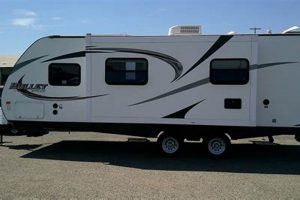
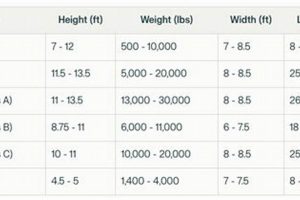
Vertical dimension of a towable recreational vehicle, measured from ground level to the highest point of the unit, is a critical specification. As an example, a typical unit may have a measurement exceeding 10 feet, impacting route planning and storage options.
Knowledge of this dimension is essential for safe navigation under bridges, through tunnels, and around overhanging obstacles. Understanding this specification prevents potential damage to the recreational vehicle and infrastructure. Furthermore, it informs storage choices, determining compatibility with covered storage facilities or parking areas.
Subsequent sections will address how to measure this dimension accurately, factors influencing its variation, and strategies for minimizing risks associated with excessive vertical clearance needs.
Height Considerations for Towable Recreational Vehicles
The following tips are designed to assist owners and prospective buyers in understanding and managing the vertical dimension of their towable recreational vehicles. Proper planning and awareness are critical for safe travel and storage.
Tip 1: Measure Accurately: Utilize a precise measuring tool to determine the vehicle’s vertical dimension from the ground to the highest fixed point. This measurement should be conducted on a level surface.
Tip 2: Account for Add-ons: Factor in any additions to the roof, such as air conditioners, antennas, or solar panels, as these increase the overall vertical dimension. Remeasure after any modifications.
Tip 3: Consult Official Specifications: Verify the manufacturer’s listed specifications, but always confirm with a personal measurement to account for variations in models and aftermarket installations.
Tip 4: Plan Routes Strategically: Prior to departure, meticulously plan travel routes, paying close attention to bridge and overpass clearance heights. Utilize GPS devices and mapping applications designed for recreational vehicles, which often include height restrictions.
Tip 5: Maintain Awareness: While driving, remain vigilant for low-hanging obstacles such as tree branches and power lines. Exercise caution in unfamiliar areas.
Tip 6: Document the Measurement: Keep a readily accessible record of the vehicle’s documented vertical dimension. This information is essential for route planning, storage, and insurance purposes.
Tip 7: Consider Adjustable Suspension: For certain vehicles, adjustable suspension systems may offer the capability to slightly lower the vertical dimension, providing added clearance when needed. Consult with a qualified technician before making any modifications.
Adhering to these guidelines minimizes the risk of damage and ensures safer and more efficient utilization of towable recreational vehicles. Prudent planning and accurate measurement contribute significantly to a positive travel experience.
The concluding section will summarize the key points discussed and offer final recommendations for responsible recreational vehicle ownership.
1. Overall dimension

The overall dimension of a travel trailer, specifically its vertical extent, directly defines its practical application and operational limitations. This dimension, commonly referred to as “travel trailer height,” dictates route feasibility, storage options, and compliance with transportation regulations. A greater vertical dimension necessitates careful route planning to avoid low-clearance obstacles such as bridges, tunnels, and overhanging structures. For example, a travel trailer exceeding 12 feet in height may be restricted from certain roadways and require detours, increasing travel time and fuel consumption.
Furthermore, the overall dimension influences storage compatibility. Many storage facilities, particularly covered or indoor units, impose limitations based on vertical clearance. Selecting a travel trailer with a lower overall dimension can expand storage options and reduce storage costs. The addition of rooftop accessories, such as air conditioning units, antennas, or solar panels, invariably increases the overall dimension, potentially exacerbating clearance issues. Accurate measurement and documentation of this dimension are therefore critical for safe and efficient use of the travel trailer.
In conclusion, the overall vertical dimension represents a fundamental constraint in the operation and storage of travel trailers. Understanding and meticulously managing this parameter is essential for avoiding costly damage, ensuring regulatory compliance, and optimizing the overall travel experience. Failure to account for the overall dimension can lead to significant logistical challenges and financial burdens, underscoring the importance of careful consideration prior to purchase and during operation.
2. Bridge clearance

Bridge clearance represents the minimum vertical space available between the roadway surface and the lowest point of a bridge’s structure. This dimension directly impacts the safe passage of vehicles, particularly those with significant vertical height, such as travel trailers. The relationship between bridge clearance and travel trailer height is critical for preventing collisions and ensuring safe transit.
- Posted Clearance
Transportation authorities are required to post the minimum vertical clearance on bridges along public roadways. These postings serve as critical information for drivers of tall vehicles. The posted clearance is often the result of engineering surveys and accounts for structural sag or other factors that may reduce the actual clearance. Ignoring posted clearances can result in severe structural damage to both the bridge and the travel trailer.
- Measurement Inaccuracies
While posted clearances are intended to be accurate, discrepancies can occur due to resurfacing of roadways, which effectively raises the road level. Drivers of travel trailers should be aware of the potential for these discrepancies and exercise caution, especially in areas with older infrastructure. Confirming the actual clearance with independent measurement, where feasible and safe, can mitigate risks.
- Route Planning
Effective route planning is essential for navigating travel trailers safely. This involves identifying and avoiding routes with bridges that have clearance heights below the travel trailer’s overall dimension. Resources such as GPS devices designed for recreational vehicles, online mapping tools, and printed road atlases can provide information on bridge clearances. Pre-trip planning significantly reduces the risk of encountering clearance issues.
- Legal Ramifications
Striking a bridge due to exceeding the posted clearance carries significant legal consequences. Drivers may be held liable for damages to the bridge, face fines, and potentially have their driving privileges suspended or revoked. Moreover, insurance coverage may be affected. Adherence to posted clearances is not only a matter of safety but also a legal obligation.
The interplay between bridge clearance and travel trailer height underscores the need for responsible vehicle operation. Proactive planning, awareness of potential inaccuracies, and strict adherence to posted clearances are paramount for ensuring the safe and legal transit of travel trailers. Failure to prioritize these considerations can lead to significant financial and legal repercussions, in addition to posing safety risks.
3. Storage compatibility
Storage compatibility, in the context of travel trailers, is directly and significantly impacted by the vehicle’s vertical dimension. This dimension, commonly measured as “travel trailer height”, dictates whether a unit can be accommodated within a given storage facility. Covered storage facilities, in particular, often have restricted vertical clearances, rendering some travel trailers unsuitable. Units exceeding these limitations must either be stored in uncovered areas, exposing them to the elements, or incur the added expense and logistical challenges of securing a storage space that accommodates their dimensions. For example, a travel trailer with a dimension exceeding 12 feet may be excluded from numerous indoor storage options, compelling owners to choose less desirable or more costly alternatives. The selection of a travel trailer should, therefore, include a careful consideration of its vertical dimension relative to available and anticipated storage options.
The influence of vertical dimension on storage extends beyond covered facilities. Even open-air storage locations may impose constraints based on overall dimensions, influencing parking arrangements and site accessibility. Furthermore, the vertical dimension of the travel trailer affects the ease of maneuvering within a storage area. A taller unit may present challenges when navigating tight corners or low-hanging branches, potentially leading to accidental damage. Conversely, a travel trailer with a lower vertical dimension often offers greater flexibility and convenience in storage scenarios. The addition of rooftop accessories, such as air conditioners or satellite dishes, must also be factored into the overall vertical dimension, further impacting storage compatibility. Failing to account for these additions can result in unexpected restrictions and storage-related complications.
In summary, storage compatibility is inextricably linked to the travel trailer’s vertical dimension. Prudent purchasers will meticulously assess available storage options and their associated vertical limitations prior to acquiring a unit. This proactive approach helps avert potential storage dilemmas and ensures the long-term protection and accessibility of the travel trailer. The integration of storage considerations into the initial purchasing decision represents a fundamental aspect of responsible travel trailer ownership, minimizing subsequent logistical challenges and financial burdens.
4. Axle configuration

Axle configuration, specifically the number and placement of axles on a travel trailer, indirectly influences the overall vertical dimension. While not a direct determinant, axle configuration affects suspension characteristics and consequently, the ground clearance of the unit, which contributes to the overall height. Understanding this relationship is pertinent for maintaining stability and clearance during transit.
- Single Axle Systems
Single axle configurations are typically found on smaller, lighter travel trailers. These systems offer simplicity in design and maintenance. However, they generally result in lower ground clearance compared to multi-axle systems. This reduced ground clearance necessitates careful navigation over uneven terrain to prevent scraping or damage to the undercarriage, indirectly affecting the effective vertical dimension by limiting operational environments.
- Tandem Axle Systems
Tandem, or dual-axle, systems are commonly employed on larger and heavier travel trailers. The presence of two axles distributes the load more evenly, enhancing stability and increasing load-carrying capacity. Tandem axle systems typically provide greater ground clearance compared to single axle systems, allowing for traversal of more varied terrain without compromising the unit’s structural integrity. This increased ground clearance contributes to a higher overall vertical dimension.
- Suspension Type
The type of suspension system used in conjunction with the axle configuration significantly affects ride height and stability. Leaf spring suspensions are a common and cost-effective option, while torsion bar suspensions offer improved ride quality and adjustability. Air ride suspension systems provide the greatest degree of adjustability, allowing for variable ride height based on load and terrain conditions. Adjustable suspension systems can be used to slightly modify the overall vertical dimension, providing additional clearance when needed.
- Tire Size and Inflation
Tire size and inflation pressure also play a role in determining ground clearance and, consequently, the overall vertical dimension. Larger diameter tires increase ground clearance, whereas underinflated tires reduce it. Maintaining proper tire inflation is crucial for optimizing both ground clearance and tire longevity. Furthermore, using tires that are not appropriately sized for the axle configuration can compromise stability and affect the vertical dimension.
In summary, axle configuration, in conjunction with suspension type, tire size, and inflation pressure, establishes the ground clearance of a travel trailer. While not the sole determinant of the overall vertical dimension, ground clearance contributes significantly to the total height and operational capabilities of the unit. Careful consideration of these factors ensures both stability and adequate clearance for safe and efficient travel.
5. Roof accessories
The addition of roof accessories to a travel trailer invariably increases the overall vertical dimension. This increase, directly affecting the “travel trailer height,” must be meticulously considered for safe navigation, storage, and regulatory compliance. Common roof-mounted accessories include air conditioning units, antennas (television, radio, satellite), solar panels, roof racks, and vent covers. Each accessory adds a measurable increment to the existing vertical dimension, potentially exceeding clearance limits for bridges, tunnels, and storage facilities. For instance, installing a rooftop air conditioning unit, which can add 10-18 inches, can significantly alter the initial dimension, necessitating a recalculation for route planning.
The influence of roof accessories on vertical dimension extends beyond mere measurement. It directly impacts route selection, requiring drivers to avoid low-clearance areas. Failure to account for the added dimension can result in structural damage to both the accessory and overhead obstacles, leading to costly repairs and potential safety hazards. Furthermore, storage options are often restricted by the augmented dimension. Covered storage facilities may become inaccessible, forcing owners to opt for outdoor storage, which exposes the trailer to weather-related degradation. An example is a travel trailer initially fitting into a standard storage unit before the addition of solar panels; the panels then render the unit incompatible, necessitating a more expensive or less convenient storage solution.
In summary, roof accessories constitute a critical factor in determining the overall vertical dimension of a travel trailer. Their addition necessitates a reassessment of clearance requirements and a revision of route planning and storage strategies. Owners must accurately measure the increased vertical dimension and diligently account for it during operation to mitigate risks and ensure regulatory adherence. The integration of these considerations into the planning process is paramount for responsible travel trailer ownership, preventing potential damage and enhancing overall safety.
6. Legal restrictions

Legal restrictions pertaining to “travel trailer height” are implemented to ensure public safety, protect infrastructure, and facilitate efficient traffic flow. These regulations vary by jurisdiction, necessitating thorough research and compliance to avoid penalties and ensure lawful operation.
- Maximum Height Limits
Most jurisdictions establish maximum height limits for vehicles operating on public roadways, including travel trailers. These limits are typically codified in transportation laws and are intended to prevent collisions with overpasses, bridges, and other overhead structures. Exceeding these height limits can result in fines, impoundment of the vehicle, and liability for damages to infrastructure.
- Permitting Requirements
In some cases, travel trailers exceeding the standard height limits may be eligible for special permits. These permits often require adherence to specific routing restrictions and may necessitate the use of escort vehicles to ensure safe passage. Obtaining the necessary permits is crucial for legal operation and avoiding significant penalties.
- Interstate Variations
Height restrictions for travel trailers can vary significantly between states or provinces. Operators traveling across jurisdictional boundaries must be aware of the regulations in each area they transit. Failure to comply with interstate variations can result in unexpected delays, fines, and legal complications.
- Enforcement Mechanisms
Enforcement of height restrictions is typically carried out by transportation authorities and law enforcement agencies. Weigh stations, inspection points, and mobile patrols may be used to verify compliance. Drivers of travel trailers exceeding the height limits may be subject to inspections, fines, and orders to correct the violation before proceeding.
Compliance with legal restrictions concerning “travel trailer height” is a fundamental responsibility for all travel trailer operators. Careful attention to regulations, proper measurement of vehicle height, and adherence to permitting requirements are essential for ensuring safe, legal, and trouble-free travel. Ignorance of these regulations is not a valid defense and can lead to significant legal and financial repercussions.
Frequently Asked Questions
This section addresses common inquiries regarding the vertical dimension of towable recreational vehicles. Understanding these aspects promotes safer travel and storage practices.
Question 1: What constitutes “travel trailer height?”
This dimension represents the vertical distance from the ground to the highest fixed point on the recreational vehicle. This measurement includes any rooftop accessories, such as air conditioners or antennas.
Question 2: Why is knowing this dimension important?
Knowledge of this dimension is crucial for avoiding collisions with low-clearance obstacles, such as bridges and overpasses. It also determines compatibility with storage facilities and adherence to legal height restrictions.
Question 3: How is this dimension measured accurately?
The measurement should be conducted on a level surface using a precise measuring tool. Ensure all rooftop accessories are included in the measurement.
Question 4: Do rooftop accessories affect this measurement?
Yes, rooftop accessories invariably increase the vertical dimension. It is essential to remeasure after any additions to the roof.
Question 5: Are there legal restrictions on vertical dimension?
Most jurisdictions impose maximum height limits for vehicles operating on public roadways. Exceeding these limits can result in fines and other penalties.
Question 6: How can potential clearance issues be mitigated?
Meticulous route planning, awareness of posted clearance heights, and accurate measurement of the vehicle’s vertical dimension are essential for mitigating potential clearance issues.
Accurate knowledge of the vertical dimension is paramount for safe and responsible recreational vehicle operation.
The following section will delve into practical tips for maximizing space efficiency within the confines of a travel trailer.
Conclusion
The preceding discussion has underscored the criticality of understanding and managing the vertical dimension of towable recreational vehicles. “Travel trailer height” directly influences route planning, storage options, regulatory compliance, and overall safety. Accurate measurement, consideration of rooftop accessories, and adherence to legal restrictions are paramount for responsible vehicle operation. Failure to address these factors can result in significant financial penalties, structural damage, and potential safety hazards.
Therefore, prospective and current owners are strongly encouraged to prioritize this dimension in all operational considerations. Diligence in measurement, planning, and awareness will contribute to a safer and more enjoyable recreational travel experience. The industry’s continued emphasis on safety and regulatory compliance necessitates a heightened understanding of these fundamental principles.