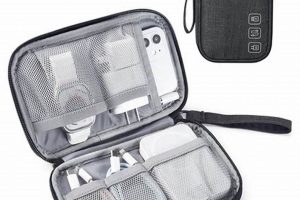
A curated collection of cosmetic applicators, designed for portability, often represents a strategic purchase for individuals who maintain a beauty routine while away from a permanent residence. These sets typically include smaller versions of standard makeup brushes for foundation, eyeshadow, blush, and other products, all housed within a compact case or container.
The utility of such kits lies in their ability to streamline the packing process and minimize bulk when traveling. A well-chosen collection ensures that essential application tools are readily available, facilitating consistent makeup application regardless of location. The development and refinement of these travel-sized tools mirrors the increasing importance placed on convenience and efficiency in the modern beauty industry.
Further discussion will detail the specific criteria to consider when selecting an appropriate set, highlight features that differentiate superior options, and provide guidance on maintaining the longevity of these valuable cosmetic accessories.
Selection and Maintenance Guidelines
The following guidelines offer practical advice for individuals seeking to acquire and preserve a portable collection of cosmetic applicators for travel.
Tip 1: Assess Brush Composition. Consider the materials used in brush construction. Synthetic bristles are often preferable for their durability, ease of cleaning, and suitability for use with both powder and liquid products. Natural bristles, while offering a softer feel, may require more specialized care and may not be ethically sourced.
Tip 2: Evaluate Brush Head Density. The density of the brush head impacts product application. Denser brushes typically provide fuller coverage, while less dense brushes offer a lighter, more diffused effect. Evaluate the desired level of coverage and blendability for each brush.
Tip 3: Prioritize Handle Length and Ergonomics. Shorter handles are advantageous for portability, but overly short handles can compromise control and precision. Seek a balance between compactness and comfortable handling. Ergonomic handle designs can further enhance user experience.
Tip 4: Inspect Case Construction and Closure. The case serves to protect the brushes from damage and contamination during transit. Examine the case’s material for durability and resistance to impact. Ensure the closure mechanism is secure to prevent accidental opening.
Tip 5: Establish Regular Cleaning Protocols. Cleaning brushes regularly is crucial to prevent bacterial buildup and maintain performance. Utilize a gentle brush cleanser and allow brushes to air dry completely before storing. Neglecting cleaning can lead to skin irritation and reduced brush lifespan.
Tip 6: Consider Brush Set Versatility. Prioritize sets that include a range of essential brushes suitable for a variety of makeup application techniques. A versatile set minimizes the need to carry additional, specialized brushes, further optimizing space and weight.
Tip 7: Evaluate Brand Reputation and Reviews. Conduct thorough research on brands and product reviews prior to purchase. Reputable brands often adhere to higher quality standards and provide reliable customer support. Reviews can offer valuable insights into product performance and durability.
Adherence to these guidelines facilitates the selection of a practical and enduring portable makeup brush collection. Attention to material quality, construction, and maintenance ensures that the selected tools remain effective and hygienic throughout prolonged use.
The subsequent sections will address the environmental considerations associated with cosmetic brush production and offer suggestions for responsible disposal practices.
1. Bristle Material

The selection of bristle material significantly influences the performance and suitability of a curated set of cosmetic applicators designed for travel. Bristle composition dictates product pickup, blendability, and ease of maintenance, all critical factors for on-the-go use. Synthetic bristles, composed of materials such as nylon or Taklon, exhibit enhanced durability and are less prone to damage from frequent cleaning, a necessity during travel. They also tend to be less absorbent than natural bristles, leading to reduced product waste and improved hygiene. Natural bristles, sourced from animal hair, may offer a softer feel but require more specialized care, including more delicate cleaning methods, which can be inconvenient while traveling. An example is a travel set containing natural bristles used with cream products. Frequent, but improper, cleaning may cause the bristles to degrade faster than a synthetic alternative.
Furthermore, bristle material impacts ethical considerations. The sourcing of natural bristles from animals raises concerns about animal welfare. Synthetic bristles offer a cruelty-free alternative, appealing to consumers with ethical purchasing preferences. The choice between synthetic and natural bristles also affects the range of products with which the brushes can be effectively used. Synthetic bristles are generally compatible with both powder and liquid formulations, whereas natural bristles may perform better with powder products due to their inherent porosity. A travel set with versatile synthetic bristles allows for streamlined use with various cosmetic formulations.
In summary, bristle material constitutes a fundamental aspect in determining the quality and practicality of a set of cosmetic applicators for travel. The selection of synthetic bristles often provides a balance of durability, ease of maintenance, ethical sourcing, and versatility, aligning with the demands of travel. Conversely, while natural bristles may offer certain aesthetic advantages, their susceptibility to damage, specialized care requirements, and ethical implications can render them less suitable for travel purposes. Ultimately, understanding the interplay between bristle material and the demands of transient use enables informed decision-making.
2. Handle Length
Handle length within a curated cosmetic applicator collection designated for travel directly influences portability and precision during application. A reduction in handle length corresponds to a decrease in overall volume, a critical attribute for mitigating space constraints within luggage. Conversely, excessively shortened handles can compromise control, leading to uneven application and diminished blending capabilities. For instance, consider a foundation brush with a disproportionately short handle; this may hinder the user’s ability to achieve a seamless, streak-free finish due to limited leverage and maneuverability. Thus, handle length functions as a determinant of both compactness and functionality.
Optimizing handle length necessitates striking a balance between spatial efficiency and ergonomic design. An illustration involves eyeshadow brushes intended for detailed work. Handles that are significantly abbreviated may prove difficult to manipulate within the confined space of the eyelid, resulting in imprecision. Longer handles, while offering enhanced control, contribute to increased bulk, potentially exceeding the limited dimensions of travel-sized cosmetic bags. Manufacturers often employ tapered handle designs to reconcile these competing demands. Such designs provide a comfortable grip while minimizing overall length, demonstrating a practical approach to optimizing space without sacrificing user experience.
In conclusion, handle length is not merely an aesthetic consideration; it is a functional component that significantly affects the suitability of any collection of cosmetic applicators intended for travel. The optimal handle length represents a compromise between portability and usability. Recognizing the interplay between these factors allows consumers to make informed decisions, selecting a set that addresses both spatial limitations and application requirements. The challenge lies in identifying products that incorporate ergonomic design principles to mitigate the drawbacks associated with shortened handles, ensuring a satisfactory user experience despite reduced dimensions.
3. Case Durability
Case durability is a critical attribute of any curated cosmetic applicator collection designed for travel. The protective casing directly impacts the longevity, hygiene, and overall practicality of the enclosed brushes, particularly when subjected to the rigors of transit.
- Material Composition and Impact Resistance
The case’s construction material significantly influences its ability to withstand external forces. Hard-shell cases constructed from materials such as ABS plastic or reinforced polymers offer superior protection against crushing and impact damage, safeguarding delicate brush bristles from deformation or breakage. In contrast, soft-sided cases, while lighter, provide minimal protection against external pressure. An illustrative example is a brush set housed in a hard case surviving intact within a checked suitcase, while a set in a soft case sustains bristle damage under the same conditions.
- Closure Mechanism and Security
The effectiveness of the case’s closure mechanism dictates its ability to prevent accidental opening and subsequent contamination. Secure closures, such as zippers with robust teeth or magnetic clasps with sufficient holding force, minimize the risk of exposure to dust, debris, and other potential contaminants during travel. Conversely, flimsy closures or those prone to failure can compromise hygiene and increase the likelihood of brush damage. A real-world scenario involves a case with a faulty zipper inadvertently opening within a travel bag, resulting in brushes becoming soiled and potentially damaged.
- Water Resistance and Environmental Protection
The case’s water resistance properties are essential for protecting the enclosed brushes from moisture damage. Water-resistant materials, such as coated fabrics or sealed seams, prevent water from penetrating the case and compromising the integrity of the brush bristles. Exposure to moisture can lead to bacterial growth, bristle deterioration, and reduced brush lifespan. An example would be a set being protected by a water resistant case when the owner is bringing it to the beach for a photoshoot.
- Internal Organization and Brush Retention
The case’s internal organization plays a crucial role in preventing brushes from rubbing against each other, minimizing bristle fraying and deformation. Designated compartments or elasticized loops provide secure retention for each brush, preventing them from moving freely within the case. Poor internal organization can result in brushes becoming tangled, misshapen, and less effective. An example is a case with individual brush slots keeping the brushes separated and protected.
These facets collectively underscore the importance of case durability in maintaining the quality and usability of curated cosmetic applicator collections designed for travel. The selection of a robust and well-designed case is paramount to safeguarding the investment in high-quality brushes and ensuring their optimal performance throughout numerous journeys.
4. Brush Density

Brush density, defined as the quantity of bristles packed into a brush head, exerts a significant influence on the performance and suitability of cosmetic applicator collections, particularly those designed for travel. The number of bristles directly impacts product pickup, application intensity, and blending capabilities, thereby affecting the overall outcome of the makeup application process. Higher density brushes generally facilitate fuller coverage and more concentrated color payoff, while lower density brushes offer a lighter, more diffused application. For example, a densely packed foundation brush provides maximum coverage for concealing imperfections, whereas a sparsely bristled powder brush allows for a subtle dusting of setting powder without appearing cakey. In the context of a travel makeup brush set, the appropriate brush density for each brush is crucial for achieving desired results with limited tools and space.
The practical significance of understanding brush density within the context of travel stems from the need for versatility and efficiency. A curated travel set necessitates brushes capable of performing multiple functions effectively. A brush with moderate density may serve as both a blush and contour brush, providing flexibility and minimizing the number of individual tools required. Conversely, brushes with excessively high or low density may limit their applicability, requiring additional specialized brushes to achieve diverse makeup looks. For example, a travel set might include an eyeshadow brush with medium density, enabling both all-over lid application and precise crease work, thus reducing the need for separate blending and detail brushes. Further to its functional impact, variations in brush density also directly affect cleaning and drying times. Densely packed brushes may take longer to dry after washing, a significant consideration for travelers with limited time and resources. A thoughtfully selected travel set would prioritize brush densities that facilitate both effective application and efficient maintenance.
In conclusion, brush density represents a key determinant of the quality and functionality of a travel makeup brush set. The selection of brushes with appropriate densities for their intended purpose optimizes product pickup, application intensity, and blending capabilities. The density also has a knock-on effect when the brushes are cleaned, and their ability to dry properly. Understanding the nuances of brush density allows consumers to make informed decisions, selecting sets that provide versatility and efficiency without compromising on makeup application quality. Recognizing the limitations associated with extremely high or low densities in the context of travel is essential for curating a practical and effective collection.
5. Set Composition

The composition of a portable cosmetic applicator collectionthe specific assortment of brushes includeddirectly impacts its suitability as a “best travel makeup brush set.” The effectiveness of such a collection hinges on its ability to address a broad spectrum of makeup application needs while adhering to size and weight constraints inherent to travel. An incomplete or poorly curated set necessitates carrying supplementary, individual brushes, thereby negating the intended convenience. Conversely, a well-composed set offers versatility and efficiency, enabling the creation of diverse makeup looks with a minimal number of tools. An example involves a set containing a multi-purpose brush that can function as a blush, bronzer, and highlighting tool, efficiently consolidating three products into one.
The selection of brushes within a set should prioritize essential functions, such as foundation application, concealer blending, eyeshadow application, blush/bronzer contouring, and brow grooming. These are areas most consumers of beauty products will want. Duplication of function should be minimized to preserve space and reduce weight. For instance, instead of including multiple eyeshadow brushes with only subtle variations in size or shape, a well-designed set may incorporate a single, versatile eyeshadow brush with a tapered shape suitable for both lid application and crease definition. The inclusion of specialized brushes, such as lip brushes or eyeliner brushes, is contingent upon the target user and the overall space limitations of the set, but can be very benificial and is up to the customer when thinking about a “best travel makeup brush set”.
In conclusion, the composition of a travel makeup brush set is paramount. The efficacy of the set is reliant on the individual selection of brushes, as well as on their ability to provide comprehensive functionality within the constraints of portability. Challenges in curating a “best travel makeup brush set” often involve balancing the need for versatility with the desire to minimize size and weight. Ultimately, a carefully considered set composition significantly enhances the overall user experience and elevates a collection from a mere assortment of brushes to an indispensable travel companion.
Frequently Asked Questions
The following section addresses common inquiries regarding the selection, use, and maintenance of portable cosmetic applicator collections, often identified as “best travel makeup brush set,” offering guidance for informed decision-making.
Question 1: What constitutes a “best travel makeup brush set” in terms of essential brushes?
An optimal curated collection should include brushes for foundation, concealer, eyeshadow, blush, powder, and brow grooming. Specialized brushes may be included based on individual needs and available space.
Question 2: What material is most suitable for bristles in a portable cosmetic applicator collection?
Synthetic bristles, typically composed of nylon or Taklon, are often favored due to their durability, ease of cleaning, compatibility with both powder and liquid products, and ethical sourcing.
Question 3: How should one clean cosmetic applicators within a “best travel makeup brush set?”
Brushes should be cleaned regularly using a gentle brush cleanser. Residue should be thoroughly rinsed, and brushes should be allowed to air dry completely before storage to prevent bacterial growth.
Question 4: What factors influence the durability of a travel cosmetic brush case?
The case material, closure mechanism, and internal organization all contribute to its overall durability. Hard-shell cases with secure closures and individual brush compartments offer the best protection.
Question 5: How does brush density impact the application process?
Brush density affects product pickup, application intensity, and blending capabilities. Higher density brushes yield fuller coverage, while lower density brushes provide a lighter, more diffused effect.
Question 6: Are there specific size considerations for handles in a “best travel makeup brush set?”
Handle length should balance portability with comfortable handling and precise application. Shorter handles are advantageous for space-saving, but excessively short handles can compromise control.
In summary, the selection of a portable cosmetic applicator collection involves careful consideration of brush material, density, case construction, and set composition. Regular cleaning and proper storage are essential for maintaining brush quality and hygiene.
The subsequent section will address environmental considerations surrounding cosmetic applicators and disposable practices.
Conclusion
The preceding analysis has illuminated key considerations regarding a curated collection of cosmetic applicators for travel, often referred to as the “best travel makeup brush set.” Elements such as bristle material, handle length, case durability, brush density, and set composition have been dissected to provide a comprehensive understanding of the factors influencing suitability and performance. These factors inform the selection process, enabling consumers to make discerning choices aligned with their individual needs and preferences.
The acquisition of an appropriate “best travel makeup brush set” represents a strategic investment for individuals seeking to maintain a consistent beauty regimen while away from home. Recognizing the nuances of each component is crucial to maximizing value and ensuring a satisfactory user experience. Continued diligence in assessing product specifications and user reviews is encouraged to facilitate the selection of a durable, versatile, and hygienic collection of cosmetic applicators for transient use.