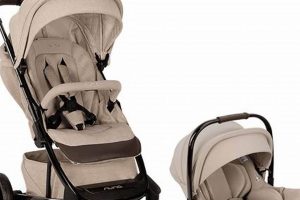
The selection of a superior restraint system for infants during air transportation prioritizes safety and regulatory compliance. These specialized seats are designed to securely hold a child during turbulence or, in the unlikely event of an emergency, offering enhanced protection compared to holding an infant in an adult’s lap. A model that exemplifies these features would be one that is FAA-approved and boasts a five-point harness system.
Employing a dedicated infant restraint system within aircraft offers multiple advantages. It significantly reduces the risk of injury to the child during flight, providing a stable and secure environment. Furthermore, it allows caregivers greater freedom of movement and reduces the physical strain associated with holding an infant for extended periods. Historically, the use of such systems has contributed to improved child safety statistics in air travel and has become increasingly encouraged, and sometimes mandated, by aviation authorities.
The following article explores the critical features, regulatory standards, and diverse options available when choosing a suitable safety device for infant air travel. It will address relevant safety certifications, size and weight considerations for ease of portability, and compatibility with various aircraft seat configurations to assist in making informed decisions.
Guidance on Selecting an Optimal Infant Restraint for Air Travel
The following recommendations outline crucial considerations for procuring a safe and effective restraint system for infants during air transportation.
Tip 1: FAA Compliance is Paramount: Ensure the chosen device bears the Federal Aviation Administration (FAA) approval sticker, signifying it meets stringent safety standards for aircraft use. This sticker confirms the restraint system has undergone rigorous testing and is certified for use on airplanes.
Tip 2: Prioritize Harness Security: Opt for a model equipped with a five-point harness system. This configuration, featuring straps over the shoulders, hips, and between the legs, provides a more secure and comprehensive restraint compared to systems with fewer points of contact.
Tip 3: Consider Dimensions and Portability: Evaluate the restraint system’s size and weight. Select a model that is both adequately sized for the infant and manageable for transport through airports and within the confines of an aircraft cabin. Lightweight designs with carrying handles are advantageous.
Tip 4: Verify Aircraft Seat Compatibility: Prior to travel, confirm the dimensions and installation requirements of the chosen restraint system align with the aircraft seat specifications. Some aircraft may have restrictions regarding seat belt length or seat width, potentially affecting compatibility.
Tip 5: Review Installation Procedures: Thoroughly understand the correct installation procedures for the restraint system. Practice installation before travel to ensure proficiency and to minimize delays or complications during boarding. Refer to the manufacturer’s instructions for detailed guidance.
Tip 6: Check for Additional Safety Features: Examine supplemental safety features such as side-impact protection or energy-absorbing foam. These elements can provide an added layer of security in the event of turbulence or other unforeseen incidents.
Tip 7: Assess the Cleanability and Durability: Evaluate the materials used in the restraint system’s construction. Opt for fabrics that are easy to clean and resistant to wear and tear, ensuring the device maintains its integrity and hygiene over time.
Adhering to these guidelines will facilitate the selection of a suitable restraint system, thereby enhancing infant safety and caregiver convenience during air travel. Careful consideration of these factors contributes to a more secure and comfortable travel experience.
The subsequent sections of this discussion will elaborate on specific models and further refine the decision-making process.
1. FAA Approval

Federal Aviation Administration (FAA) approval is a non-negotiable prerequisite when selecting a suitable infant restraint for air travel. It serves as the primary indicator that the device meets established safety standards mandated for use aboard commercial aircraft, thereby directly impacting its suitability as a the restraint device. Understanding the implications of this approval is critical for responsible decision-making.
- Regulatory Compliance and Safety Standards
FAA approval signifies that the restraint system has undergone rigorous testing and complies with Federal Aviation Regulations (FARs). These regulations dictate specific performance criteria related to crashworthiness, flammability, and restraint effectiveness, ensuring the device provides adequate protection in the event of turbulence or impact. Absence of this approval indicates a failure to meet these critical safety benchmarks.
- Permissibility on Aircraft
A restraint system lacking FAA approval may be prohibited for use during flight by airline personnel. While some airlines may permit certain car seats regardless of approval, it is the responsibility of the caregiver to ensure that the seat in question meets safety standards and regulations. Presenting a restraint system bearing the designated FAA approval label eliminates ambiguity and ensures compliance with airline policies.
- Liability and Insurance Implications
Utilizing an FAA-approved restraint system can have implications for liability in the event of an accident or injury during air travel. Insurance providers may scrutinize whether the restraint system was FAA-approved when evaluating claims, potentially affecting coverage if a non-approved device was used. Adhering to recommended safety practices, including the use of approved devices, can mitigate potential legal and financial risks.
- Labeling and Identification
FAA-approved restraint systems are typically marked with a clearly visible label indicating compliance with FMVSS 213 and bearing the statement “This restraint is certified for use in motor vehicles and aircraft.” This label serves as proof of certification and should be readily accessible for inspection by airline staff. Caregivers should verify the presence and legibility of this label prior to using the restraint system during flight.
Therefore, FAA approval is not merely a desirable feature but a fundamental requirement for a restraint system that aims to provide the optimal level of safety and regulatory compliance. The presence of this certification offers assurance that the device has been tested to meet standards and is suitable for installation on aircraft. Selecting a restraint system without FAA approval compromises infant safety and may result in denied use by the airline, rendering it unsuitable for air travel.
2. Harness Security

Harness security constitutes a critical element in evaluating the suitability of a restraint device. It is a primary determinant of the level of protection afforded to the occupant during turbulence or, in a far less probability, in the event of an emergency landing. A well-designed harness system effectively distributes impact forces across the infant’s body, minimizing the risk of injury to vulnerable areas such as the head, neck, and spine. Inadequate harness security may result in the infant being ejected from the device during a sudden deceleration, negating its protective function.
The effectiveness of a harness system is contingent upon several factors, including the number of harness points, the adjustability of the straps, and the strength of the buckle mechanism. A five-point harness, with straps securing the infant at the shoulders, hips, and between the legs, is generally considered superior to systems with fewer points of attachment. Adjustable straps allow for a customized fit, ensuring that the harness is snug but not overly constricting. A robust buckle mechanism prevents accidental release during flight. For instance, a loose harness may allow excessive movement during turbulence, while a weak buckle could fail under stress, increasing the risk of harm.
In summary, harness security represents an indispensable aspect of the selection process, directly affecting infant well-being during air travel. The choice of a system that prioritizes harness design and functionality contributes significantly to mitigating the potential risks associated with air transportation. Selection criteria should give high weighting in choosing a restraint system, as the risk of choosing poorly would be detrimential. The level of impact protection would be low and possibly cause harm to the infant due to the lack of the device safety level.
3. Size/Portability
The dimensions and weight of an infant restraint system significantly impact its suitability for air travel. While safety features are paramount, a device’s size and portability directly affect caregiver convenience and feasibility of use within the constraints of an aircraft cabin and airport environment. A bulky, heavy restraint system can present challenges during transportation through airports, security checkpoints, and boarding procedures. For example, maneuvering a large restraint alongside luggage and an infant can be physically demanding and time-consuming, potentially increasing stress and the likelihood of delays. Selecting a restraint system that strikes a balance between safety and manageable dimensions is crucial for a seamless travel experience.
Considerations beyond physical strain include aircraft storage space and compatibility with overhead compartments. An oversized restraint system may not fit within the designated storage areas, necessitating gate checking, which can increase the risk of damage or loss. Furthermore, some airlines impose size restrictions on carry-on items, potentially preventing the restraint system from being brought onboard altogether. The selection process should, therefore, incorporate an assessment of the restraint’s dimensions against airline policies and the caregiver’s ability to comfortably manage its transport. An example would be the Cosco Scenera NEXT, which is known for being lightweight and compact, making it a popular choice for air travel despite not having all the premium features of larger, heavier models.
In conclusion, size and portability are not merely secondary considerations but integral components of the overall suitability of a restraint system for air travel. While safety remains the top priority, the practical implications of size and weight on caregiver convenience and airline compliance cannot be overlooked. Selecting a restraint system that aligns with these practical constraints ensures both a safe and manageable travel experience, mitigating potential logistical challenges and reducing the physical burden on caregivers.
4. Aircraft Compatibility

Aircraft compatibility is an indispensable factor when determining a superior infant restraint system for air travel. Its relevance stems from the variability in aircraft seat dimensions, seat belt lengths, and attachment mechanisms, each influencing the secure and proper installation of an infant restraint. A restraint system, regardless of its safety ratings or features, is rendered ineffective if it cannot be correctly installed within the confines of a specific aircraft seat. The absence of compatibility presents a direct threat to infant safety during turbulence or emergency situations, as the device may fail to perform as intended. Therefore, a leading restraint system must exhibit adaptability to diverse aircraft configurations to ensure consistent protection across varying flight scenarios. The Evenflo Tribute LX Convertible Car Seat is a compact and lightweight car seat that fits well in most airplane seats, making it a popular choice for parents.
The practical implications of aircraft compatibility extend beyond immediate safety concerns. Selecting a restraint system without verifying its compatibility can lead to denied boarding or the inconvenience of having to gate-check the device, potentially increasing the risk of damage during handling. Furthermore, incompatible restraint systems may require improvisation during installation, compromising the integrity of the restraint and increasing the likelihood of misuse. Careful consideration of aircraft seat dimensions and restraint system specifications is crucial to avoid these complications and ensure a smooth and safe travel experience. For example, understanding whether the aircraft uses a lap belt only or a lap-and-shoulder belt is vital, as some restraint systems require specific belt configurations for proper installation. The Britax One4Life ClickTight All-in-One Car Seat features an easy installation and can be used with both types of belts.
In summary, aircraft compatibility represents a fundamental aspect of the overall suitability of an infant restraint system for air travel. Addressing this consideration proactively mitigates potential safety risks, logistical challenges, and unnecessary stress during the travel process. A comprehensive understanding of aircraft seat configurations and restraint system requirements allows caregivers to make informed decisions, ultimately contributing to a safer and more comfortable flight for both the infant and the accompanying adults.Air travel with small children is stressful. Don’t let your infant car seat be another challenge to face during your travels.
5. Installation Proficiency

Installation proficiency forms a cornerstone of effective infant restraint during air travel. Even the most advanced and certified seat, commonly referred to as a leading model in infant safety, yields minimal benefit if improperly installed. The relationship between installation technique and the effectiveness of a restraint is direct: improper installation compromises the restraint’s ability to protect the infant during turbulence or, in the case of an emergency landing. A real-world example of this is when a parent does not correctly thread the airplane seatbelt through the car seat’s belt path. It is crucial to ensure the seat does not move more than 1 inch in any direction. If more than 1 inch, this causes the seat to have the potential to injure your infant. Understanding and executing correct installation procedures is, therefore, an indispensable component of selecting a safety seat for air travel.
Incorrectly installed restraints can create several hazardous conditions. A loose seat may allow excessive movement during impact, potentially leading to head trauma or spinal injuries. Straps that are not properly tightened or positioned can fail to adequately restrain the infant, increasing the risk of ejection or contact with interior surfaces. Further, an improper angle can affect the infants airway, increasing the risk of breathing complications. Proficiency in installation also involves familiarity with the specific installation requirements for different aircraft seat configurations. For instance, the seatbelt routing path may vary between aircraft models, necessitating adjustments to the installation technique. Caregivers must be prepared to adapt to these variations to ensure consistent safety across different flight scenarios. An example would be referring to the FAA document that shows video demonstrations for properly installing car seats in airplanes.
In conclusion, while selecting a certified infant restraint represents an initial step toward ensuring safety during air travel, the benefits are only fully realized through proper installation. The challenges of achieving consistent installation proficiency can be addressed through thorough familiarization with the restraint’s instructions, practice sessions prior to travel, and seeking assistance from qualified professionals when needed. Prioritizing installation proficiency alongside device selection strengthens the overall safety framework, mitigating potential risks and enhancing the well-being of infants during air transportation.
Frequently Asked Questions
This section addresses common inquiries regarding the selection and utilization of infant restraint systems during air travel, providing clarity on key considerations and best practices.
Question 1: What constitutes an FAA-approved infant restraint system, and how can this approval be verified?
An FAA-approved infant restraint system meets Federal Aviation Administration safety standards for use on commercial aircraft. Verification involves locating the label indicating compliance with FMVSS 213 and stating “This restraint is certified for use in motor vehicles and aircraft.” This label must be permanently affixed to the restraint system.
Question 2: Is the use of an infant restraint system mandatory for air travel?
While not universally mandated by all airlines, utilizing an FAA-approved infant restraint system is strongly recommended by aviation safety experts. It provides a higher level of protection compared to holding an infant in an adult’s lap during turbulence or an emergency.
Question 3: What are the primary advantages of a five-point harness system compared to other restraint configurations?
A five-point harness system distributes impact forces across the shoulders, hips, and crotch, offering superior restraint and minimizing the risk of ejection or injury to the infant’s head, neck, and spine during a sudden deceleration.
Question 4: How does one ensure the chosen infant restraint system is compatible with the aircraft seat?
Compatibility assessment involves consulting the aircraft manufacturer’s specifications for seat dimensions and verifying that the restraint system’s dimensions align with these specifications. It is advisable to contact the airline directly to confirm any specific restrictions or requirements.
Question 5: What are the potential consequences of improperly installing an infant restraint system on an aircraft?
Improper installation can compromise the restraint system’s ability to protect the infant, increasing the risk of injury during turbulence or an emergency landing. A loose or incorrectly secured restraint may fail to adequately restrain the infant, leading to potential ejection or contact with interior surfaces.
Question 6: What steps can be taken to enhance proficiency in installing an infant restraint system prior to air travel?
Proficiency can be improved through thorough review of the manufacturer’s instructions, practice sessions prior to travel, and consultation with certified child passenger safety technicians (CPSTs) for guidance on correct installation techniques.
The information above summarizes key aspects of restraint systems. Adhering to these considerations enhances safety and compliance.
This document offers valuable insight into ensuring safer travels. The article’s next section will provide additional information.
Conclusion
The preceding discussion has explored critical facets of selecting an appropriate infant restraint system for air travel. The emphasis has been on Federal Aviation Administration (FAA) compliance, harness security, manageable size, aircraft compatibility, and installation proficiency. Successfully integrating these elements translates to improved safety and regulatory adherence during air transport.
The ultimate objective remains safeguarding the well-being of infants during air travel. Continuous vigilance, informed decision-making, and adherence to established safety guidelines are paramount. Caregivers are encouraged to prioritize these considerations to ensure the safest possible flight environment for their children, and to remain updated as aviation safety standards evolve.
![Guide: Best Car Seat for Air Travel [Safety Tips] | Best Travel Tips for Adventurers: Explore the World on a Budget](https://detravellers.com/wp-content/uploads/2026/05/th-35-300x200.jpg "Guide: Best Car Seat for Air Travel [Safety Tips] Best Travel Tips for Adventurers: Explore the World on a Budget")